A quiet, museum-style 3D model of the power block that housed a Chernobyl-type RBMK-1000 reactor, intact at first and then lifted apart in five stages into 26 systems and about 7,200 pieces. Two more views show a flat steam-circuit diagram and an animated 3D schematic of how heat becomes motion. It explains the reactor's design; it does not show the 1986 accident.
Chernobyl Atlas is a 3D model of the power block that housed a Chernobyl-type reactor, shown whole and then lifted apart. It opens on a pale grey-blue building with a stepped roof, a reactor hall and a tall lattice stack on a plain base. You drag to turn it and open it in five stages: the roofs lift off, the walls slide outward, the equipment hall opens, and at the end 26 separate systems hang in the air around the reactor. It is a viewer, not a game: no score, nothing to win, and it does not depict the accident.
It is the original creator's own page, not a recreation: one 750 KB HTML file published from the public GitHub repository bubblik525/Chernobyl_Atlas, announced in a post by the X account @k1rallik (BuBBliK) on 12 September 2026. The post says he started from the idea of making the reactor explorable, and that a few iterations later GPT Astra had produced an interactive exhibit with thousands of modelled elements. We cannot check the prompts. The page does show 26 systems adding up to 7,192 separate 3D objects, so that count holds. He published several atlases of this kind in the same week, under the same @kirallik signature.
The subject is a real disaster in which people died, and the page treats it as engineering. Unit 4 of the Chornobyl plant in Ukraine was destroyed by an explosion early on 26 April 1986. According to the World Nuclear Association, two people died at once or soon after, and 28 more died of acute radiation syndrome within weeks. None of that is shown here. The building is intact when the page opens, and what you see is what the reactor and its building were designed to be: a stylised model, not a survey of the real plant, and it says so.
How to play Chernobyl Atlas
- Power block (first tab). Drag to orbit; you cannot go under the base and there is no panning. The mouse wheel does not zoom: scrolling over the model opens the building, and scrolling back closes it. The slider along the bottom (0 to 100 percent) does the same, the round play button runs the whole opening once in about ten seconds, and five stage buttons over the model jump to Whole block, Roof and services, Open the halls, Inside RBMK and Full anatomy. Auto orbit turns the camera slowly on its own.
- The left panel has two tabs. Systems lists the 26 groups with their piece counts, from Auxiliary buildings (2,328) and Building façades (2,176) down to the Refuelling machine (7). A switch hides or shows each group, a filter narrows the list to Structure or Equipment, and clicking a name or a part of the model shows its name at the top right. Visuals has four looks (Solid, Blueprint, Inside, Exploded), a Part spacing slider from 1 to 3.4 times, switches for Wireframe, Transparent shell, System colors, Section cut, Assembly guides, Part labels, Dark studio and Channel highlights, and a Reactor only button that hides the building and opens the reactor to about two-thirds. Reactor close-up zooms in on the reactor.
- Steam circuit (second tab) is a flat diagram of fuel channels, separator drums, turbine, generator, condenser and pumps, joined by moving dashes for steam, water and electricity. Clicking a part, or one of the six buttons under it, highlights it, and that is all it does.
- Reactor in motion (third tab) is a dark 3D schematic of the same loop: steam bubbles rising in the fuel channels, a turning turbine and pump, markers moving along the pipes. You can pause it, switch steam, water and rotation on and off, add a translucent outer shell, set the speed from a quarter to double, orbit, zoom with the wheel or a pinch, and jump the camera between six stops.
Controls: Drag to orbit. Mouse wheel over the model (or the slider, or play) opens the building in five stages; five stage buttons jump between them. The left panel switches 26 systems on and off and offers Solid, Blueprint, Inside and Exploded looks, a part-spacing slider and other switches. Three tabs change view: Power block, Steam circuit and Reactor in motion (pause, steam, water, rotation, outer shell, speed, six camera stops).
Click Fullscreen above the game for the largest play area. If the game does not load, use Open in new tab to play it directly from our copy.
Why it's worth your time
What checks out. We compared the page with the World Nuclear Association's pages on the RBMK and on the accident. The RBMK is graphite-moderated, with each fuel assembly in its own vertical pressure tube; water boils in the tubes and the steam goes straight to the turbine, with no heat exchanger; each of the two loops has two horizontal steam drums, four in all, as drawn here; fuel is changed while the reactor runs, by a machine on the hall deck. The page's Unit 4 and its date, 26 April 1986, are right.
What is simplified. The author's README calls the page an artistic, educational reconstruction, not a surveyed model, with proportions, equipment placement, channel counts and motion simplified. The Fuel channels system has 267 pieces and Control channels 18, while the real Unit 4 core had 1,661 fuel channels and 211 control-rod channels (Wikipedia, for second-generation RBMKs). The schematic shows one turbine and one generator; the real unit had two turbogenerators, one per loop. The lattice stack is decoration, which the page's own notes call "not a reactor cooling tower".
Text you cannot see. The page's code carries field notes for each of the 26 systems, a note reading "Unit 4 · 26 April 1986", a disclaimer ("Chernobyl-inspired reconstruction. Simplified RBMK anatomy; channel counts are illustrative") and a link to the Chornobyl plant's page on the reactor type. In the published page the stylesheet hides all of it, so a visitor sees only short captions such as "Conceptual / not to scale" and "Illustrative motion, not a physics simulation". No date appears on screen. The explanations are in the README, which lists the Chornobyl NPP page, the IAEA's INSAG-7 report and the World Nuclear Association as sources; we keep the README beside our copy.
Using it. On a desktop GPU it ran at 53 to 60 frames per second in every view, with all 7,192 pieces open. Labels are small, mostly 7 to 10 pixels, and in a 900-pixel-high window the left panel is cut off at the bottom until you scroll it.
Rights and offline use. The page needs no server and makes no network requests: the geometry is generated in code by Three.js 0.159, with no fonts, models or images downloaded. Our copy is the original file, byte for byte, with only the mirror shim added. The repository has no licence file, so the work is the author's and all rights remain his; it does carry a THIRD_PARTY_NOTICES file with the MIT licence for Three.js, and we keep that beside the copy. If you write about it, link to the original and to his post.
How we found it. Every entry in this catalogue was found through Tripo's GPT-6 Astra prompt collection, and this one is listed there as "Chernobyl Atlas". The credit is the creator's; the page and code are his own.
How it was made and where it lives
Published on GitHub Pages from a public repository. The author publishes as bubblik525. Original: https://bubblik525.github.io/Chernobyl_Atlas/ATELIER-Reactor.html. The Play button above runs our own unmodified copy, so the game keeps working here if that page goes down — which on free hosting usually has nothing to do with the author. Nothing about the game itself is changed, and the original stays linked from every page.
The post that led us here
BuBBliK@k1rallikThis is insane - GPT Astra built me Chernobyl in 3D
I started with a simple idea: make the reactor explorable. A few iterations later, we had an entire interactive 3D exhibit.
→ Thousands of modeled elements → 26 systems to show or hide → A power block that unfolds layer by layer → Animated steam, water, and turbine motion
If you like Chernobyl Atlas, try these
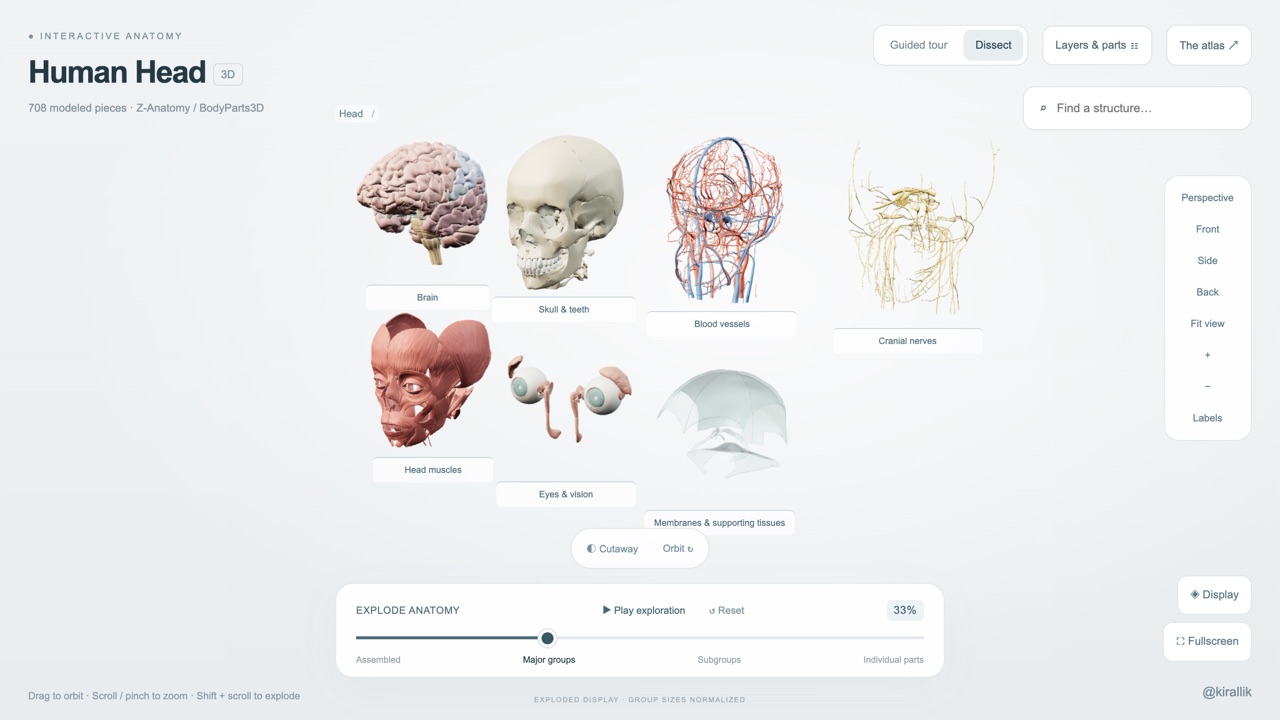
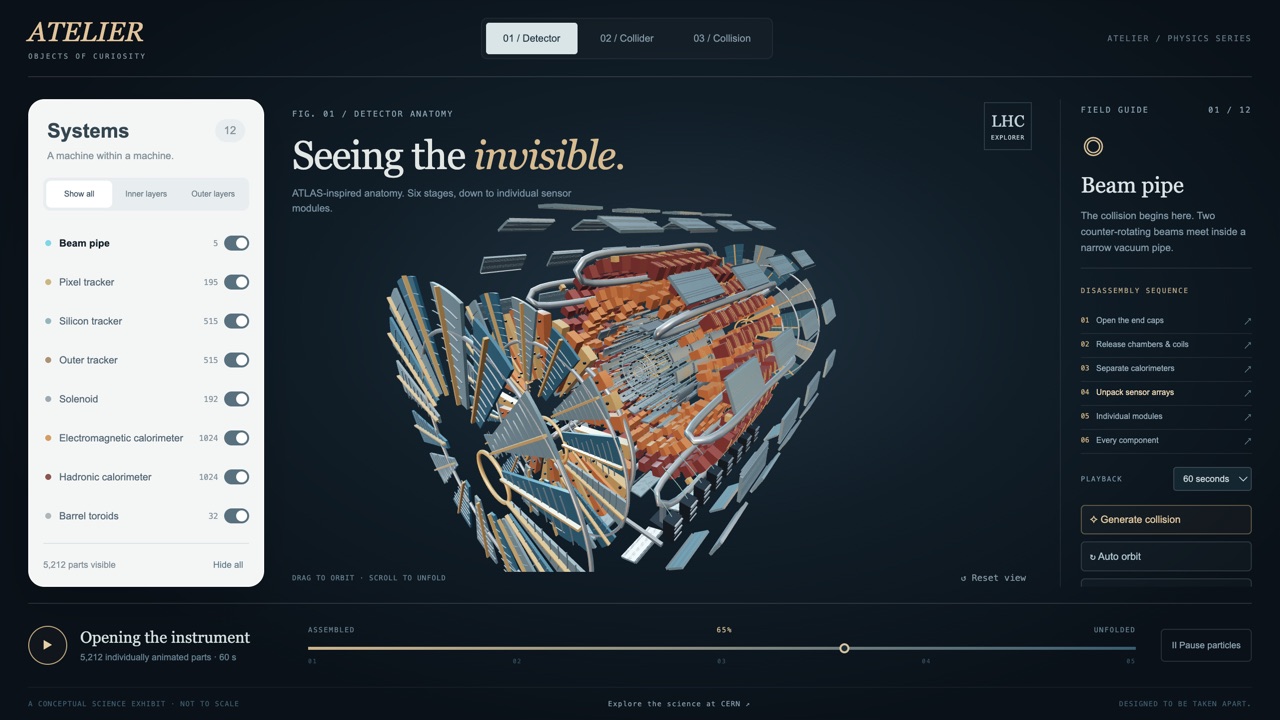
For the same author's take-apart exhibit of a very different machine, see Collider Explorer. For another atlas you peel apart layer by layer, this time of the human body, see Human Head Atlas.
Frequently asked questions
- Is this a game?
- No. It is a viewer for a stylised 3D model of a reactor building and its systems. There is no score, goal or fail state.
- Does it show the 1986 accident?
- No. The building is intact when the page opens and nothing depicts an explosion, damage or radiation. The author's README says it does not simulate the accident.
- Is the model accurate?
- In outline, yes; in detail, no. The reactor type, the direct steam cycle, the graphite and pressure tubes and the four separator drums match what the World Nuclear Association describes. Channel counts, the single turbine, the building's shape and the site are simplified, as the README says.
- Why is it signed @kirallik when the announcing account is @k1rallik?
- The page header is signed @kirallik and the announcing X account is @k1rallik. That profile links to the GitHub account bubblik525, which owns the repository.
- Does it work on a phone?
- Yes, with limits. One finger rotates the model, and you open the building with the slider or the stage buttons. Type is small, and the Reactor in motion view shows only part of its loop until you pinch out.
- Does it work offline?
- Yes. It is one HTML file with everything built in, including the 3D library.
- Is Chernobyl Atlas free to play?
- Yes. Everything on Floating Arcade is free, with no account, ads or downloads.
- Can I embed this game on my own website?
- Yes — copy the snippet below. The embedded player links back here, which is how we ask to be credited.
Embed Chernobyl Atlas on your site
Paste this where you want the game to appear: