Scroll into an illustrated black cat, watch it fade away over a 3D brain built from the CATLAS cat-brain atlas, then separate its 74 regions, follow illustrative signal paths between the hemispheres and step through a single neuron. An educational visual by BuBBliK; the neuron and pathways are labelled as illustrations, not measured cat wiring.
Brain Cat is a scrolling explainer about the inside of a cat's head. It opens on a large illustrated black cat with wide white eyes, under the words "Curiosity. From the inside." As you scroll, the cat fades to a ghost and a real 3D brain shows through; keep going and the brain breaks into separate pieces joined by coloured signal lines. Two more chapters follow: Connections, where signal lines cross between the two hemispheres, and The neuron, a single stylised nerve cell you can step through. It is a viewer, not a game: no score, no goal.
It is the original creator's own page, not a recreation. The post announcing it comes from BuBBliK (@k1rallik on X) on 13 September 2026, quoted in the box below; he says it started as one ChatGPT prompt, that GPT-6 Astra helped build it, and that he used publicly available CATLAS anatomy and published neuroscience research. The hosted address is a ChatGPT Sites page under the account name succinct-kirallik, and the code is in a public GitHub repository, bubblik525/cat_brain_anatomy. He published several anatomy pages like this one in the same week.
The brain geometry is CATLAS, an MRI-based 3D atlas of the domestic cat cerebral cortex published in 2017 by Daniel Stolzberg, Christina Wong, Blake Butler and Stephen Lomber, built on an averaged 7-tesla scan of eight adult cats (per the paper's abstract). The page uses 74 labelled surfaces from it, split down the middle into 148 pieces you can show or hide by side. Everything else, meaning the cat picture, the way the brain sits inside it, the signal lines and the neuron, is illustration, and the page says so in several places.
How to play Brain Cat
- Scroll (or drag the Explore deeper slider, or pinch on a touchscreen). Around a quarter of the way in, the cat turns translucent and the brain shows through its head; by about half way the cat is gone; near the end the regions pull apart and thin coloured lines with moving dots link them. Each wheel notch moves it roughly a quarter of the way. Dragging the picture rotates the brain (drag or press an arrow key while still on the cat and it jumps ahead to the brain).
- The buttons at the top of the scene, The cat, Brain and Explode, jump between the states. In Brain view you get a plain rotate-and-zoom model with a Separate the regions slider, and a tool column with perspective, top and side views, auto-rotate and reset. Hover a region for a label such as "17 · Vision"; click to select it. "Inspect region" isolates it on its own, and Restore all layers brings everything back.
- Find a region opens a search box (press / anywhere). It matches names, atlas codes and system names: typing "vis" lists the Vision-system areas, such as 17, 18, 19, 20a and 21a. The Layers panel has three looks (Natural, Colour, which paints the six systems, and X-ray, which shows the pathways inside a translucent surface), switches for surface, pathways, signal trails, region labels and a wireframe, a Surface opacity slider, six system chips that hide or show a whole system, and Both, Left and Right for one hemisphere.
- Connections is the second tab. Signal studio offers three pathway layouts: Cross the midline, Stay in one hemisphere, and Sensory relay. Beside them are three animation styles (Stream, Burst, Wave), switches for fibre bundles, travelling signals and reverse direction, a Brain opacity slider (0 to 70 percent), and Pause, Restart and a Speed slider from 0.25 to 2 times. The hemispheres are tinted green (L) and purple (R).
- The neuron is the third tab: a 3D nerve cell with branching dendrites, a cell body, a segmented myelinated axon and a terminal reaching a second, purple cell. A five-step list (Dendrites, Cell body, Axon, Axon terminal, Synapse) runs by itself, a yellow dot marking the stage. Click a stage to pause on it and read one line; Pause, Restart and Speed work as in Connections. The ? button opens a four-card guide, and Credits opens the sources.
Controls: Scroll, drag the slider or pinch to reveal the brain from the cat. Drag to rotate, wheel to zoom, click a region to select it, press / to search. Anatomy, Connections and The neuron are the three chapters; Layers and the signal controls are on the side and bottom.
Click Fullscreen above the game for the largest play area. If the game does not load, use Open in new tab to play it directly from our copy.
Why it's worth your time
What signal does the neuron follow? A generic one, and the page says so. The five stages are the textbook path of a nerve impulse: inputs at the dendrites, the cell body combining them to a threshold, the impulse along the axon, neurotransmitter released at the terminal, and the synapse passing it on. A badge reads "Educational 3D model · not a reconstructed cell", and a note says the glowing dot marks a stage, not a particle. It is not a visual or cat-specific neuron. The post lists three things he learned about visual neurons (angle-tuned edge detectors, motion-direction cells, organised crossings between hemispheres); in this build I found only a "Visual cortex · edges, motion" label and a credits line citing Hubel and Wiesel, no demonstration, and the repository's validation notes say an earlier vision-lab section was removed.
The pathways are drawn, not measured. The lines join the centre points of chosen atlas regions (visual, motor, auditory, somatosensory and others), and Signal studio's footer reads "Illustrative paths · not tractography". The brain's placement in the cat is schematic too: halfway through the reveal it floats over the cat's forehead and eyes, larger than the drawn head, and the repository notes say no registration between the cartoon and the MRI atlas was attempted.
Depth is thin. The guide says "Select a coloured region for its function and source", but a selected region shows only a name, its atlas code and its system. Only 28 of the 74 regions have a plain-English name in the code (Primary visual cortex, Prefrontal cortex and so on); the other 46 appear as "Area 20a"-style codes. It is good for looking and searching, not for learning what each area does. The page notes that the atlas does not segment all deep structures and that its cerebellum is a coarse supplied surface.
Facts I checked. The CATLAS abstract describes 71 cortical areas on the averaged 7 T scan of eight cats, so the page's 74 surfaces is a few more and the page does not explain the difference. The credits' figure of about 250 million cortical neurons matches the cat value in Jardim-Messeder and colleagues (2017). The Hubel and Wiesel cat visual cortex paper and the Payne and Siwek paper on the visual map in the cat's corpus callosum exist as cited. I did not check every reference. This is a teaching illustration, not veterinary advice.
Rights, in the author's own words. The repository has no licence file. The credits and the ATTRIBUTION.md file say the brain data comes from CATLAS by Stolzberg, Wong, Butler and Lomber (2017; paper at doi.org/10.1002/cne.24271, data at github.com/CerebralSystemsLab/CATLAS), that the CATLAS repository "does not contain an explicit standalone data license", that the atlas rights remain with its authors, and that this is an "attributed educational visualization". The black-cat portrait is described as artwork supplied by the user, keeping its existing rights, with no new licence asserted; the page does not say who drew it. Three.js (r180, MIT) is included with its licence. We host a mirror for preservation, credit the author and the atlas, and keep the author's attribution file with it: read the attribution (the same text as the original ATTRIBUTION.md, shown as a web page). Anyone who wants to reuse the atlas data or the cat picture should ask their owners, as the attribution file itself advises.
Loading and speed. About 5.7 MB in total: a 3.3 MB binary of atlas surfaces (about 182,000 triangles, per the author's notes), Three.js, a 470 KB cat image and one font (Golos Text) that the original fetches from Google Fonts. It loaded in about two seconds locally and ran at about 60 frames per second in all three chapters on a desktop graphics card (one machine, not a benchmark). Our copy makes no requests to other sites.
Access. On 19 September 2026 the ChatGPT Sites address answered every request with a "Sign in required" screen. The README warns of this ("The hosted demo may require the owner's access") and offers running the dist folder locally. The GitHub Pages copy of that folder is public, and this mirror was made from it; I could not compare it with the gated version.
How we found it. Every entry in this catalogue was found through Tripo's GPT-6 Astra prompt collection at tripo3d.ai/3d-prompts/models/gpt-6-astra, where this is listed as an interactive 3D anatomy explorer. The credit is BuBBliK's, and the anatomy is the CATLAS authors'.
How it was made and where it lives
Published through ChatGPT Sites (chatgpt.site) — the same hosting pipeline GPT-6 Astra uses to ship playable games straight from a prompt. The author publishes as succinct-kirallik. Original: https://brain-cat-illustrated.succinct-kirallik.chatgpt.site. The Play button above runs our own unmodified copy, so the game keeps working here if that page goes down — which on free hosting usually has nothing to do with the author. Nothing about the game itself is changed, and the original stays linked from every page.
ChatGPT Sites is the hosting side of the workflow OpenAI describes for building games with GPT-6 Astra: the model writes the game, then publishes it to a public address in one step. That is why so many of the newest single-file browser games are appearing on chatgpt.site domains.
The post that led us here
BuBBliK@k1rallikHoly moly… Astra helped me build an interactive cat brain
After the FlyBrain rabbit hole, I wanted to understand the brain behind the creature that keeps knocking things off my desk.
No cats were harmed. I used publicly available CATLAS anatomy and published neuroscience research.
It started with one ChatGPT prompt. A few iterations later: Brain Cat.
Zoom into a black cat. Watch it fade to reveal its brain. Rotate it, separate regions, toggle layers, and explore animated neural signals.
If you like Brain Cat, try these
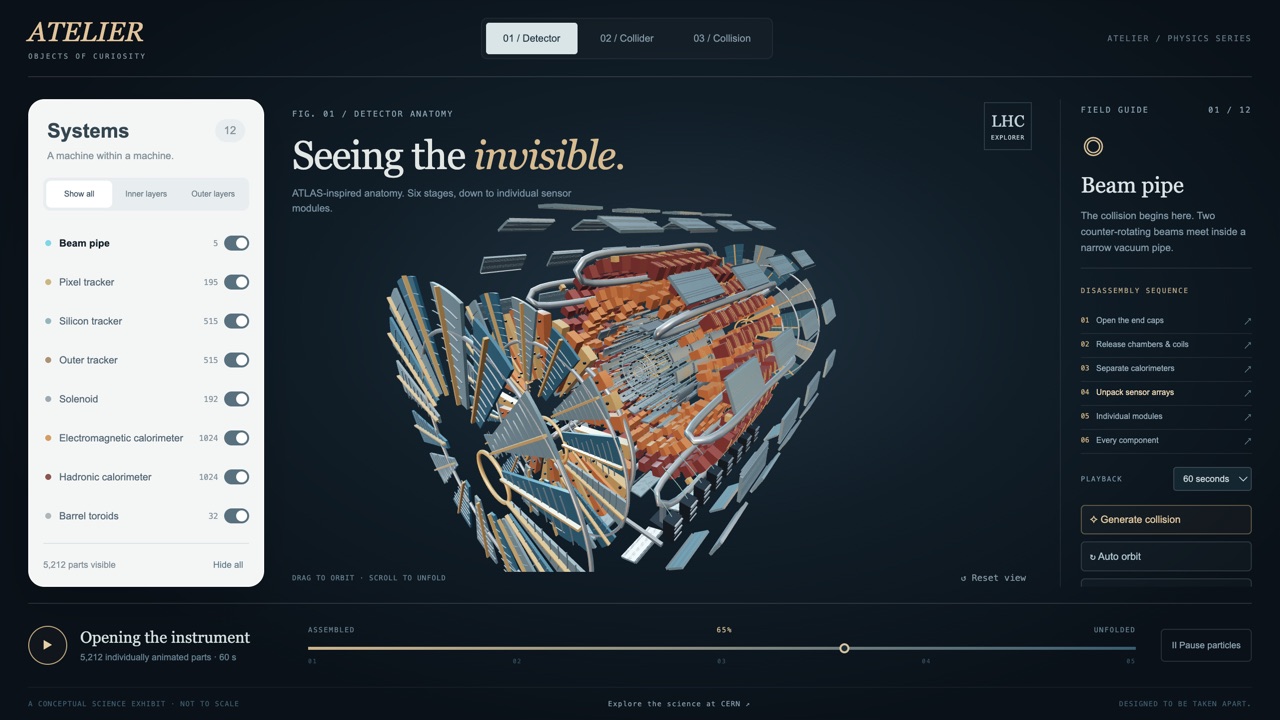
For another take-it-apart explainer by the same author, try Collider Explorer, which pulls an LHC-style particle detector apart layer by layer.
Frequently asked questions
- Is this a game?
- No. It is an interactive explainer with three chapters and no score or goal.
- Is it a real cat brain?
- The brain surfaces are real: they come from the CATLAS MRI atlas, made from an averaged scan of eight adult cats. The cat picture, the way the brain sits inside it, the coloured pathways and the neuron are illustrations, and the page labels them as such.
- What does the neuron chapter show?
- A generic, stylised nerve cell passing an impulse through five stages: dendrites, cell body, axon, axon terminal and synapse. It is not a reconstructed cat neuron and not a visual neuron.
- Can I see what each region does?
- Only partly. You can search and select any of the 74 regions and see its name (or code), its atlas number and its system (Vision, Movement, Touch, Hearing, Integration & more, Cerebellum), but there is no per-region description in this build.
- Does it work on a phone?
- Yes, in a 390 by 844 emulation: swipe to rotate, pinch to reveal, and the panels open over the scene. The Layers button overlaps the headline on the opening screen and the neuron is cropped at the right edge.
- Who made it, and can I reuse it?
- BuBBliK (@k1rallik on X), with GPT-6 Astra. The repository has no licence, and the atlas data and the cat picture keep their owners' rights, so reuse needs their permission; Three.js is MIT. Nothing here is veterinary advice.
- Why is the original address asking me to sign in?
- The ChatGPT Sites link returned a sign-in page when we tried it, and the README says the hosted demo may need the owner's access. Our copy is made from the public GitHub Pages files and opens without a login.
- Does it work offline?
- Our copy does. The original loads one font from Google Fonts and otherwise runs from local files.
- Is Brain Cat free to play?
- Yes. Everything on Floating Arcade is free, with no account, ads or downloads.
- Can I embed this game on my own website?
- Yes — copy the snippet below. The embedded player links back here, which is how we ask to be credited.
Embed Brain Cat on your site
Paste this where you want the game to appear: