A dark, museum-style page that takes apart a simplified ATLAS-style particle detector, 5,212 separate pieces in twelve systems, in six stages you drive by scrolling or playing it over 30, 60 or 90 seconds. Two more views show a schematic accelerator ring with counter-rotating beams and a camera flight around it, and a synthetic collision display. Its own notes call the geometry and tracks illustrative, not data.
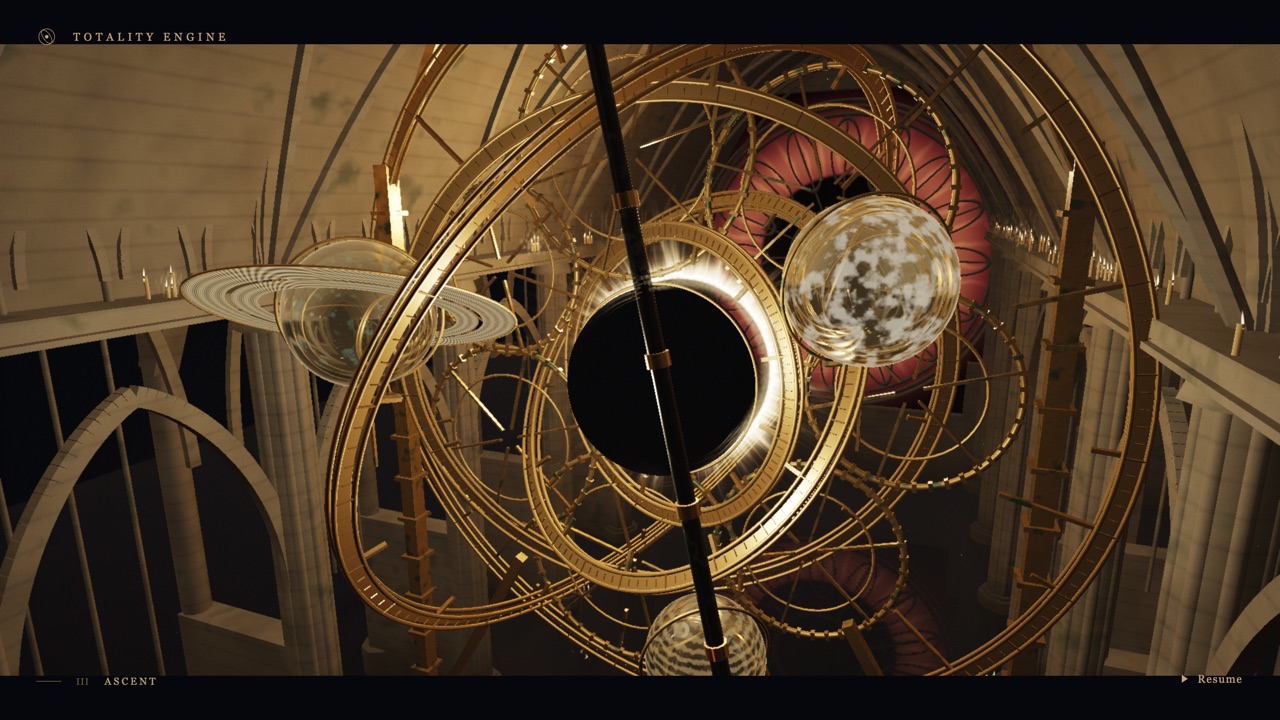
Collider Explorer is an exhibit page about a particle detector. The first thing you see is a large drum of blue-grey wheels, copper and red rings, gold rails and grey sensor panels, modelled loosely on ATLAS, one of the big experiments at CERN's Large Hadron Collider. You take it apart. Scroll the mouse wheel, drag the slider or press play, and the end wheels slide off along the beam line, the outer panels lift away, the rings of calorimeter blocks pull apart, and in the last stage thousands of small pieces spread out around a bare beam pipe. It is a viewer, not a game.
It is the original creator's own page, not a recreation: a single 545 KB HTML file on GitHub Pages, published from the public repository bubblik525/collider, and announced in a post by @k1rallik (BuBBliK). The post says one prompt to Astra started it and "a few refinements" turned it into 5,212 animated components. We cannot check the prompt or the refinements. The count we can check: the page lists twelve systems whose pieces add up to exactly 5,212.
The browser tab and page header say ATELIER ("Seeing the invisible / LHC"); the repository and README call it Collider Explorer, the name used here. Three tabs at the top pick the view: 01 Detector, 02 Collider and 03 Collision.
How to play Collider Explorer
- Detector, the opening view. Drag to orbit. The mouse wheel does not zoom, it unfolds the machine, and scrolling back up closes it (about 1,700 pixels of wheel travel from closed to fully open). The slider along the bottom and the round play button do the same. Six stage buttons on the right jump to set points: Open the end caps (14 percent), Release chambers and coils (30), Separate calorimeters (46), Unpack sensor arrays (65), Individual modules (84) and Every component (100). A menu beside them sets playback to 30, 60 or 90 seconds; we timed each and the slider moved at those rates. Reassemble slowly runs it backwards at the same speed, and pressing play again pauses.
- The left panel lists twelve systems, from the beam pipe to services and cabling, each with a piece count and an on/off switch. Show all, Inner layers (3,470 pieces) and Outer layers (1,742) are quick filters, and a running total follows your switches. Click a system name, or the model itself, and the field guide on the right gives a one-sentence explanation of it, short and generic.
- Collider. The detector is replaced by a ring of 120 small magnet modules with a blue beam of dots running one way and an orange one the other, and four labelled boxes: ATLAS, CMS, ALICE and LHCb. The left panel gives the ring's size as "27 km", with switches for the beam dots and the magnets and a beam-speed slider. Scrolling pulls the magnets apart. "Fly around the ring" gives you a camera that glides along the outside of the ring, a lap of about 63 seconds, and disables dragging until you press it again. Clicking one of the four labels does not open that experiment; it just takes you to the Collision view.
- Collision. The detector appears as faint ghosts, about 35 percent unfolded, with a burst of about 90 thin coloured lines drawn out from the centre over a second or two and a badge reading SYNTHETIC EVENT with a number. A new burst replaces it every five seconds, or at once when you press Generate collision. Pause particles freezes the tracks (and the beam dots and the flight, which share one clock); the button then reads Resume.
Controls: Drag to orbit. Mouse wheel unfolds the machine (scroll up to close it), or use the slider or the play button; six stage buttons jump to set points and a menu picks 30, 60 or 90 seconds. Switches turn each of 12 systems on and off, and the three tabs at the top change view. No keyboard shortcuts.
Click Fullscreen above the game for the largest play area. If the game does not load, use Open in new tab to play it directly from our copy.
Why it's worth your time
It says what is not real, and we checked that claim. The right-hand panel ends with "Simplified geometry; animated paths are illustrative, not experimental data", the footer reads "A conceptual science exhibit, not to scale", the Collision view labels itself "Synthetic tracks, not a physics simulation", and the Collider panel says "Geometry and speed are schematic". The README repeats it. On a window under about 800 pixels high the first of those sits below the fold of the scrolling right panel.
In the source, each track is a nearly straight line at a random angle with a small random bend, so the burst is a drawing, not a calculation. The "5,212 components" are 3D shapes in the model, not the real detector's module count: the electromagnetic calorimeter's 1,024 is 32 sectors of 8 layers of 4 shapes each.
We checked a few stated facts against CERN's own pages. The ring's "27 km" matches CERN's "approximately 27km in circumference"; CERN says the beams travel in opposite directions in separate beam pipes and collide at four points, as the page shows; and CERN describes ATLAS's barrel toroid as eight coils, like the page's eight "Barrel toroids". We did not check every sentence or the layer order.
Rough edges. The ticks under the slider are numbered 01 to 05 while there are six stages. In the Collider view the field guide keeps showing whatever system you last chose (End-cap assemblies, when we looked), which is unrelated. With the machine well open, some pieces are cut off by the edge of the picture area at the top and bottom, and the wheels can run off its left side.
Speed. It ran at about 35 frames per second at 1440 by 900 in a Chromium window on a Mac, and about the same in a phone-size window. That is one machine, not a benchmark.
Licence and privacy. The repository has no licence file and GitHub lists none, so the code is public but nothing says what you may reuse. The only third-party notice is the MIT licence for the embedded Three.js. The page makes no network requests; its only external link is the "Explore the science at CERN" footer line, followed only when clicked. Our copy is the original file plus one small script that keeps file paths inside this site, and it works offline.
The creator published several atlas-style pages in the same week. How we found it: every entry in this catalogue was found through Tripo's GPT-6 Astra prompt collection, where it is listed as an interactive 3D particle collider with a suggested prompt. The credit is BuBBliK's; that listing presents the prompt as a starting point for something similar, and we do not know the page was made from exactly that text.
How it was made and where it lives
Published on GitHub Pages from a public repository. The author publishes as bubblik525. Original: https://bubblik525.github.io/collider/ATELIER-Collider.html. The Play button above runs our own unmodified copy, so the game keeps working here if that page goes down — which on free hosting usually has nothing to do with the author. Nothing about the game itself is changed, and the original stays linked from every page.
The post that led us here
BuBBliK@k1rallikOne prompt to Astra started a 3D particle collider. A few refinements turned it into 5,212 animated components you can take apart. Scroll, and the detector opens layer by layer: End-cap wheels slide away. Giant magnets separate. Calorimeters split into modules. Thousands of tiny sensors emerge. Follow particle beams around the ring. Generate a synthetic collision and freeze its tracks. One HTML file. No installation. Just your browser.
If you like Collider Explorer, try these
For another 3D machine you can pull apart part by part, see RB19 Engineering Lab, an interactive look at a Formula 1 car. For another page that draws a scientific idea as a quiet 3D scene, see One Millionth.
Frequently asked questions
- Is this a game?
- No. It is an educational viewer: you take a detector apart, look at a schematic ring and watch a made-up collision. There is nothing to win.
- How do I take the detector apart?
- Scroll the mouse wheel over the picture, drag the slider along the bottom, press the play button, or press one of the six stage buttons. The 30/60/90-second menu sets how long play takes, and Reassemble slowly runs it backwards.
- Is the collision real data?
- No. The lines are generated from random numbers and the page labels them a synthetic event, illustrative and not a physics simulation.
- Are the 5,212 parts the real number of parts in ATLAS?
- No. They are 3D shapes in this page's own simplified model, and the total is the sum of the twelve system counts shown in the panel.
- Is the 27 km figure correct?
- As a round number, yes: CERN gives about 27 km for the LHC's circumference. The ring on screen is a schematic circle, not to scale.
- Does it work on a phone?
- Yes, in a phone-size emulation: one finger rotates, and the slider and play button unfold the machine. The stage buttons and speed menu are hidden at that width, there is no zoom, and only part of the ring fits in the Collider view. We did not try a real phone.
- Can I reuse the code?
- The repository is public but has no licence file, so it does not say. Only the embedded Three.js has a licence notice (MIT). Ask the author before reusing it.
- Does it work offline?
- Yes. It is one self-contained file, and our copy makes no requests to other sites.
- Is Collider Explorer free to play?
- Yes. Everything on Floating Arcade is free, with no account, ads or downloads.
- Can I embed this game on my own website?
- Yes — copy the snippet below. The embedded player links back here, which is how we ask to be credited.
Embed Collider Explorer on your site
Paste this where you want the game to appear: