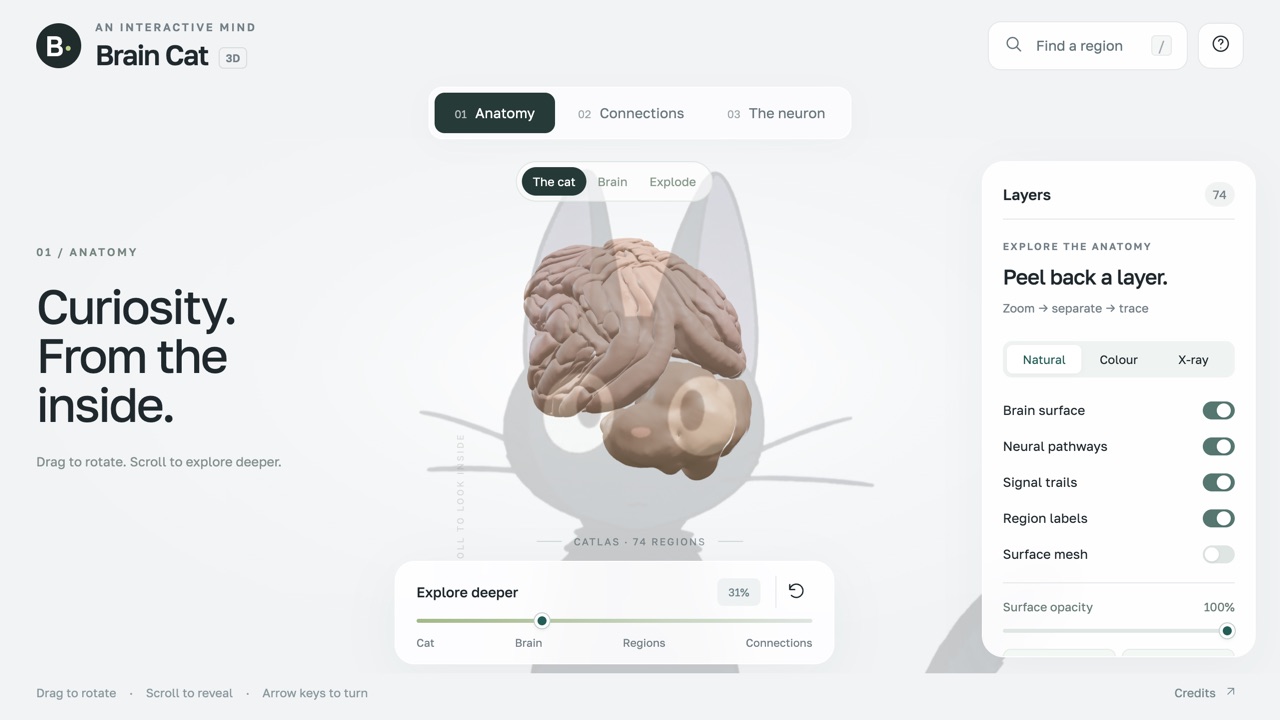
A light-themed 3D atlas of the human head and brain with 708 anatomical parts in seven systems: peel the brain, skull, muscles, blood vessels, cranial nerves and eyes apart level by level, hide or fade any part, search for a structure, slice with a clipping plane, and save a PNG. Built with Three.js, works offline, and credits its anatomy to Z-Anatomy and BodyParts3D (CC BY-SA).
Human Head Atlas is a 3D model of a human head that you can take apart. It opens as an assembled head with facial muscles, blood vessels and nerves over the skull, and from there you peel it back layer by layer, down to single teeth, single folds of the cortex and single nerves. There are 708 separate anatomical parts in seven systems, in a light, uncluttered interface with a structure tree, a search box and a slider that explodes the whole model. It is a viewer, not a game: nothing is scored.
It is the original creator's own page, not a recreation. The live page and its public GitHub repository (bubblik525/head) belong to BuBBliK, who posts as @k1rallik on X. In his post of 10 September 2026 he says he asked GPT-6 Astra to build a human head he could take apart, and that the idea became this atlas, refined through conversation from one prompt. The page's header calls it "Human Atlas Nº 02", which suggests one of several such atlases he published that week.
One plain sentence first: this is educational anatomy of a representative adult, not a patient scan, and it is not medical advice or a clinically validated tool.
How to play Human Head Atlas
- The page opens in Dissect mode with the head assembled. Drag to orbit and use the wheel or a two-finger pinch to zoom. Buttons on the right give Perspective, Front, Side and Back camera angles, Fit view, zoom and a Labels toggle; F fits the view, / jumps to the search box and Escape closes panels.
- To take the head apart, drag the slider at the bottom. It has four stops: Assembled, Major groups, Subgroups, Individual parts. At Major groups the head separates into its seven systems in a labelled grid: Brain, Skull and teeth, Blood vessels, Cranial nerves, Head muscles, Eyes and vision, and Membranes and supporting tissues. At the last stop all 708 parts are laid out separately, 24 to a page over 30 pages, with arrows to page through. Shift plus wheel moves the slider, and Play exploration animates it: about 40 seconds from assembled to fully separated in our test, where it stops.
- The structure tree (Layers and parts) is how you dissect on purpose. It starts at Head with part counts: Brain 247, Skull and teeth 60, Blood vessels 207, Cranial nerves 54, Head muscles 102, Eyes and vision 32, Membranes 6. Click a name to open it: Brain opens into Deep nuclei, Cerebrum, Ventricular spaces, Diencephalon, Cerebellum and Brainstem; Cerebrum into hemispheres, then lobes, then single gyri and sulci, with a breadcrumb trail and a Parent button. Each row has a switch to hide it, a Group opacity slider fades the current group, and Hide group, Restore all and Undo do what they say. Hide, undo and restore worked in our test.
- Search finds structures by name ("hippocampus" gives left and right). You must click a result; Enter does not pick the first. Selecting a part, by search or by clicking it on the model, opens a card with its name and a one-line note and four buttons: Inspect closely (flies the camera to it), Isolate (shows only that part), Hide part and Explore parent.
- Guided tour is the other mode. It swaps the slider stops for four chapters (The head, The cortex, Deep within, Networks) and adds a left-hand list of systems and, with the brain in view, presets for All brain, Cerebellum, Brainstem and Ventricles. We saw Hemispheres, which pushes the two halves of the cerebrum apart to show their inner faces, in this mode. Cutaway (opens the near side of the skull) and Orbit (automatic rotation) work in both.
- The Display button opens a panel with four surface styles (Anatomical colours, Porcelain, Wireframe, Transparent) and a section plane: sagittal, axial or coronal, with a position slider and a Reverse box. It warns that clipped surfaces are open and this is not a medical scan, and the cut does show hollow shells. Save model PNG exports the current view as a 1440 by 900 PNG with a transparent background (about 400 KB). Reset restores the start state.
Controls: Drag to orbit, wheel or two-finger pinch to zoom, Shift + wheel (or the bottom slider) to explode. Click a structure to select it, or type in the search box (press / to focus it). F fits the view, Escape closes the panels. Guided tour and Dissect switch modes; Display holds surface styles, section planes and PNG export.
Click Fullscreen above the game for the largest play area. If the game does not load, use Open in new tab to play it directly from our copy.
Why it's worth your time
The geometry is not the author's own, and the licence matters. The meshes come from Z-Anatomy, itself derived from BodyParts3D; the data adds up to 2,238,431 triangles. The attribution page (mirrored here) says the adapted geometry is distributed under Creative Commons Attribution-ShareAlike 4.0, credits Z-Anatomy (Gauthier Kervyn, Marcin Zielinski, Lluis Vinent, CC BY-SA 4.0) and BodyParts3D (Database Center for Life Science, Kousaku Okubo, CC BY-SA 2.1 Japan), acknowledges Brainder white-matter data and Cranial Nerves and Foramina (University of Dundee, CC BY 4.0), lists the changes made, and says an upstream inner-ear mesh marked CC BY-NC-SA was left out.
What that obliges, as far as we can tell (we are not lawyers): credit the sources, link the licence, say what was changed, and share adaptations under the same licence. Our copy is unmodified in content and carries the attribution: it is inside the page (open "The atlas" at the top right), and the author's attribution page and project page are mirrored. That attribution page also says it grants no extra licence for the application code, and the repository has no licence file, so treat the code as the author's and the anatomy as CC BY-SA.
Size, and what we changed. The original is one HTML file of 30,016,369 bytes (28.6 MiB), because the mesh data is embedded as base64 text. Our host refuses single files over 25 MiB, so here the 1,416 base64 strings (positions and indices, two per part) were moved verbatim into four script files of 6 to 8 MB that load before the page's own script, which refers to them by index. Nothing else in the application was touched, and putting the strings back reproduces the original file exactly. It still works offline.
Performance. On a desktop GPU (Apple M4) it loaded from disk in about three seconds and ran at 51 to 55 frames per second with about 130 to 150 MB of JavaScript memory. Wireframe mode dropped to about 15 frames per second. There were no page errors.
Details. The note on a part is specific for some structures (the hippocampus card explains its role in memory) and generic for others (a muscle such as the frontalis just says it is a head muscle from the source atlas). In an emulated 390 by 844 touch phone the page fits with no sideways scroll, one finger orbits, a pinch zooms and the tree becomes a sheet over the model; the real cost on a phone is the 28.6 MiB download. The page credits "@kirallik" (spelled with an i) for the interface, while his X account is @k1rallik.
How we found it. Every entry in this catalogue was found through Tripo's GPT-6 Astra prompt collection, where this one is listed as an interactive 3D atlas of the human head and brain; the credit for the page is the creator's.
How it was made and where it lives
Published on GitHub Pages from a public repository. The author publishes as bubblik525. Original: https://bubblik525.github.io/head/human-head-anatomy.html. The Play button above runs our own unmodified copy, so the game keeps working here if that page goes down — which on free hosting usually has nothing to do with the author. Nothing about the game itself is changed, and the original stays linked from every page.
The post that led us here
BuBBliK@k1rallikI asked GPT-6 Astra to build a human head I could take apart. That idea became an interactive 3D atlas with 708 anatomical structures.
> Real anatomical atlas geometry > Individually explorable brain regions, nerves, and blood vessels > Runs offline in a single HTML file
You can hide the skull to reveal the brain, make layers transparent, and separate entire systems into smaller structures.
If you like Human Head Atlas, try these
For other models you take apart, see RB19 Engineering Lab, an interactive look inside an F1 car, and Collider Explorer, which strips a particle detector down.
Frequently asked questions
- Is this a game?
- No. It is an interactive anatomy viewer with no score or goal.
- Is it medical advice?
- No. It is educational anatomy of a representative adult, not a patient scan and not clinically validated. The clipping planes make open surfaces, not real slices.
- Where does the anatomy come from, and can I reuse it?
- From Z-Anatomy and BodyParts3D. The adapted geometry is distributed under CC BY-SA 4.0: credit is required and adaptations must be shared under the same licence. Read the attribution page and the upstream licences before reusing anything; the application code has no separate licence.
- Does it work offline?
- Yes. It makes no network calls of its own. Our copy uses four extra script files beside the page because of a host file-size limit.
- Does it work on a phone?
- Yes in our emulated phone, with one-finger orbit and pinch zoom. It is a 28.6 MiB page and the author warns it can be demanding on older devices.
- What can I export?
- A PNG of the current view, from the Display panel.
- Who made it?
- BuBBliK (@k1rallik on X, bubblik525 on GitHub), who says he built it with GPT-6 Astra.
- Is Human Head Atlas free to play?
- Yes. Everything on Floating Arcade is free, with no account, ads or downloads.
- Can I embed this game on my own website?
- Yes — copy the snippet below. The embedded player links back here, which is how we ask to be credited.
Embed Human Head Atlas on your site
Paste this where you want the game to appear: