You are eight, you have eaten every cookie, and Mum is home in fifteen minutes. Walk the rooms of the house in first person, spend your few minutes tidying the clues that could give you away, then face Mum and answer her questions in your own words. She remembers what you say, and there are four endings.
The Cookie Jar is a short first-person game about a very small crime. You are eight, you have just eaten every cookie in the jar, and a note on the screen says Mum is home in 15 minutes. You walk round a low-poly house in soft green and orange, find what could give you away (the lid on the floor, crumbs on the table, chocolate on your chin, a packet on top of the bin), fix some of it, and then Mum comes in and asks you about the rest. You type your answers yourself, and she remembers what you said earlier.
The trick is that you cannot fix everything. Looking around is free, but crossing a doorway costs a minute and so does most cleaning up, and some fixes cause new problems: we scrubbed our chin with the facecloth and the game immediately added "the facecloth covered in chocolate" to our list. The game's tagline, on its title screen, is "Cover your tracks. Keep your story straight."
It is Game No. 004 on the free-games hub of Chong-U (@chongdashu), at play.aioriented.dev/the-cookie-jar, and it is played on Wavedash, a game platform, where it was published on 19 September 2026. Wavedash's page says it is "Powered by Jev by Typesafe", and the title screen says "nothing is generated, everything is judged". The hub says of its author: "AI has made the process much faster, and I share how I make each one." That is a line about all his games; the game's own pages do not say which tools or models were used for this one, so this entry does not say either. We link to it rather than host a copy; the reasons are at the end.
How to play The Cookie Jar
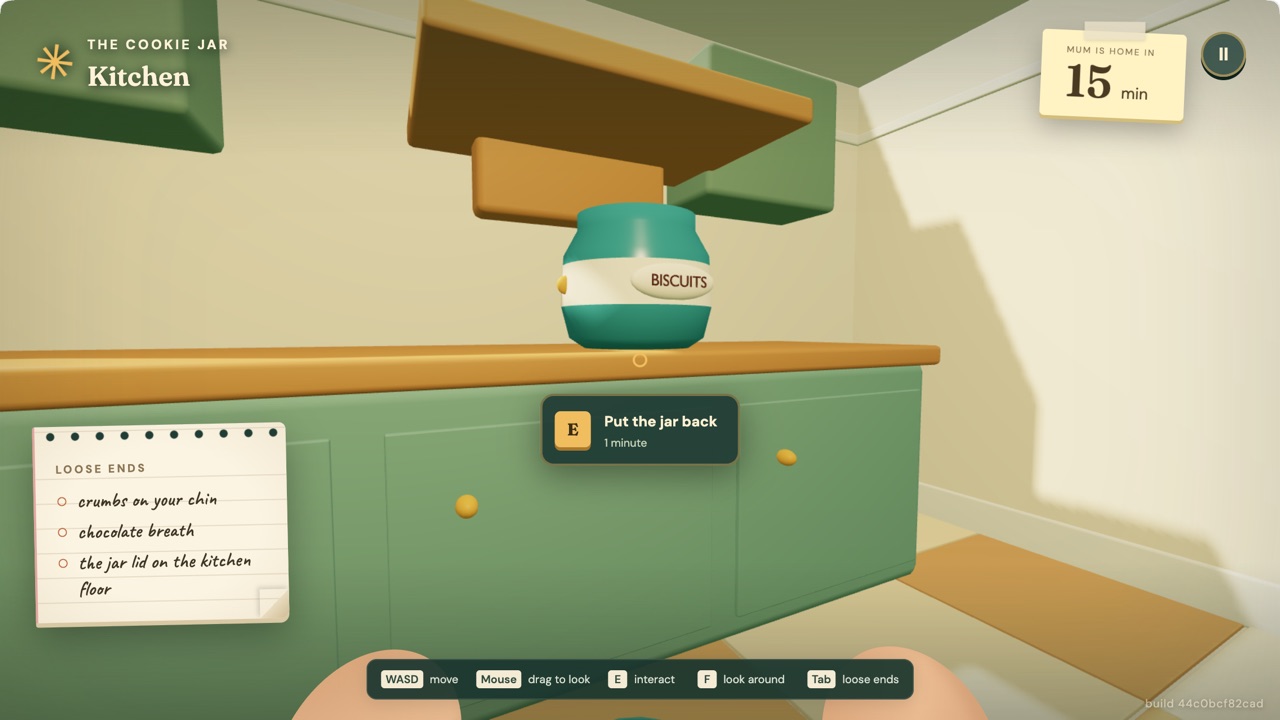
- Open the Wavedash page and the game loads on its own (a loading bar, then a title screen). Press Cover my tracks, then click through a four-card intro ("You ate every last one.", and so on); Space skips it. You start in the kitchen, facing the biscuit jar on the counter, with a clock note in the corner ("Mum is home in 15 min") and a notepad on the left called Loose Ends.
- Walk with W A S D and drag the mouse to look around. When you look at something you can deal with, a prompt appears with a key and a cost, for example "E, Put the jar back, 1 minute", and pressing E does it and takes that many minutes off the clock. Press F to look around the room properly: it costs nothing, and it adds the clues you had not noticed to your Loose Ends list (in the kitchen it added the jar on the counter, the empty packet on top of the bin and crumbs on the dining table). Hold Tab to read the list any time. The pause card also says that Shift+E picks the other option on some things, and that C wipes your chin on your sleeve for free.
- The house has six places: the Kitchen, the Hallway, the Living room, the Bathroom, Your bedroom and the Garden. Every doorway costs a minute (the game says so as you cross: "Hallway · one minute gone"). From the game's own list of things to do, you can put the lid and jar back, sweep crumbs, take the rubbish out, let the dog in and mop its paw prints, flip the chocolate cushion, ask your sister to keep quiet, brush your teeth and wash your face, hide the dirty facecloth, change your shirt, raid the piggy bank, do some homework so you look good, and hide the packet under the bed or bury it in the garden. We only did a few of these in one run: the lid, the jar, brushing our teeth and washing our face.
- When you are done, Mum comes home. The pause card has a Wait for Mum button that asks "Call it here?" and lists the loose ends still out (we did not let the clock run down on its own, so we cannot say what happens then). A "What Mum noticed" sequence then shows the clues she found one by one (Clue 1 of 4, and so on, with Next clue, Pause sequence and Skip to questions buttons). Then she asks up to six questions, each with a Suspicion meter that goes from Low to Rising to High. Type a reply in the box and press Enter; some questions also have a Show the clue button (we did not press it).
- In our run Mum asked "How was school?", then about the chocolate on the facecloth, the packet on the bin, the crumbs on the table and what our sister said. Our answers were a mix of fibs and dodges, and after the fifth reply the game ended the questioning early. Reaching a suspicion of 9 means grounding. The ending was "Busted.", with "4 loose ends tidied · 5 answers given". From the game's code, the other three endings are "You got away with it", "One last cookie" (you confess) and "Too good at lying"; we saw only Busted.
- After the ending, Why this outcome? opens "The case, explained": the final suspicion, and a row for each answer showing how much it changed Mum's suspicion, with the reason (for ours: a reply that conflicted with the evidence Mum had, one that did not answer the question, and one that sounded evasive or defensive). Your Choices lists each decision beside how many other finished runs made the same one, and Fair, Unfair and Confusing buttons let you rate the verdict. One more cookie? starts again.
Controls: W A S D walk, drag the mouse to look, E fixes what you are looking at (Shift+E takes the other option where there is one), F looks around the room for free, hold Tab to read your list of loose ends, C wipes your chin on your sleeve for free, the II button pauses. When Mum is home, type your answer in the box and press Enter or Say it.
Why it's worth your time
What we did with it. We played it on 24 September 2026, in real desktop Chrome on a Mac with WebGPU, with a script that sent keyboard and mouse input and read the game's own status readout to tell which room we were in. In a plain headless Chromium the Wavedash page never showed the game, so a browser with a working graphics chip is needed. We played one run to the end and the results above are from that run; we did not try the other endings, most of the interactions, or the bedroom and garden. The dialogue is not fixed, so another run, or another answer, will not read the same.
Your typing leaves your computer. Every reply you type is sent, with your run, to a server the author runs (an address under workers.dev), and the game reports usage events to it too. The Wavedash player hands the game a generated player name and a token, so we did not sign in, and the game's Your Choices panel is built from other players' finished runs on that server. We did not see what happens after the reply is sent, so we cannot say more about how Mum's answers are produced than what Wavedash's page and the title screen say.
It is built like a small engine. The game reports its own renderer as Rust, wgpu and WebAssembly, with a WebGPU backend, around 110,000 triangles on screen. The house is one 2 MB model and the objects (the jar, the bin, the dog, Mum, your sister) are small separate models. There are three music tracks, one for the title, one while you walk and one when Mum is home, and short sound effects for each action (a door, a brush, water, footsteps, a sting for being grounded); the browser we drove is silent, so we did not hear them. There is a Sound on and off button on the pause card.
It is very new. Wavedash's page shows it as released and last updated on 19 September 2026, five days before we played, and the build number on screen was 44c0bcf82cad. The community figures in the ending screen come from only a handful of finished runs at the moment, and the game itself labels them an early, small sample.
The game page on Wavedash also offers Favorite, Donate, Comments, Achievements and Leaderboards. We did not use them.
How it was made and where it lives
Published on Wavedash, a browser-game platform that serves the game only through its own player. The author publishes as Chong-U. Original: https://wavedash.com/games/the-cookie-jar. We link to the original instead of hosting a copy. The game runs inside Wavedash's player, and its files answer "Unauthorized" unless they are asked for by that player with a session token; Wavedash's terms bar copying material from the site, by hand or with a script, without written consent, and we have no such consent. The game also sends everything you type to Mum to a server the author runs, so a copy here would still be talking to his server. The author's hub page says the same about embedding: no portal embed and no alternate play link, the Wavedash build is the one to play.
If you like The Cookie Jar, try these
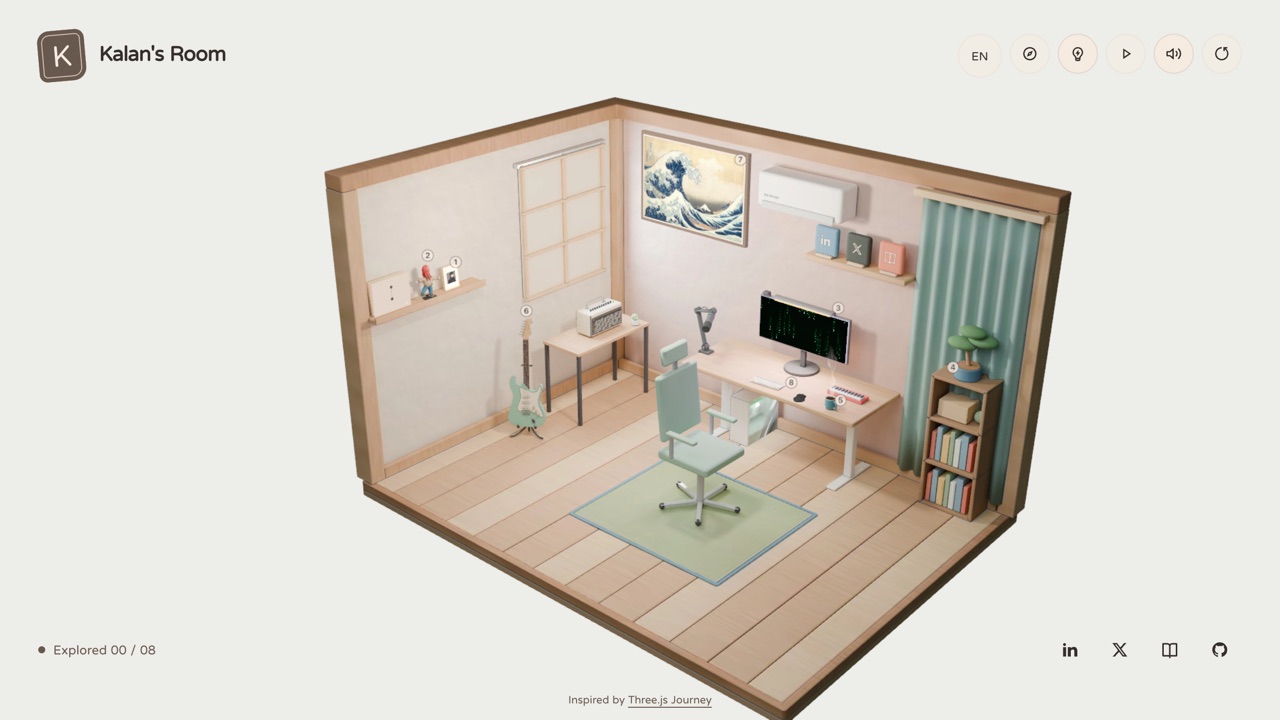
For another game where the point is walking around a small 3D room and poking at things, try Kalan's Room, a portfolio built as its creator's own room.
Frequently asked questions
- What do I do in it?
- You are an eight-year-old who has eaten every cookie. You walk the house, fix or hide what could give you away in the 15 minutes before Mum comes home, and then answer Mum's questions by typing. Some clues you can fix, some you have to talk your way around, and you cannot do everything.
- How long is a run?
- The clock in the game is 15 minutes, but that is game time, and each fix or doorway takes one minute off it. How long it takes in real time depends on how much you look around and how carefully you write your answers.
- What are the endings?
- Four: "Busted" (grounded), "You got away with it", "One last cookie" (you confess) and "Too good at lying". We got Busted; the other three names are from the game's code.
- Do I have to type my own answers?
- Yes. Mum asks you a question and you type a reply in the box in your own words. She remembers what you said earlier, so a fib can catch up with you. We did not try single-word or nonsense replies.
- Does it work on a phone?
- Probably not in a useful way. Wavedash lists keyboard and mouse as the input, the author's hub says desktop WebGPU, and we found no touch controls in the code. The page and the title screen load in an emulated phone, but we did not play it there.
- Who made it, and with what?
- Chong-U (@chongdashu), Game No. 004 on his hub, published on Wavedash on 19 September 2026. Wavedash's page says it is powered by Jev by Typesafe. His hub says AI has made his process much faster and that he shares how he makes each game, but the game's own pages do not say which tools or models built this one, so we do not say.
- Why can I not play it on this site, like most of the others?
- Its files can only be fetched by Wavedash's own player, which hands out a session token; asked directly they answer "Unauthorized". Wavedash's terms do not allow copying material from the site without written consent, and the game sends your replies to the author's own server, so a copy would still depend on it. It is free: play it at the original address.