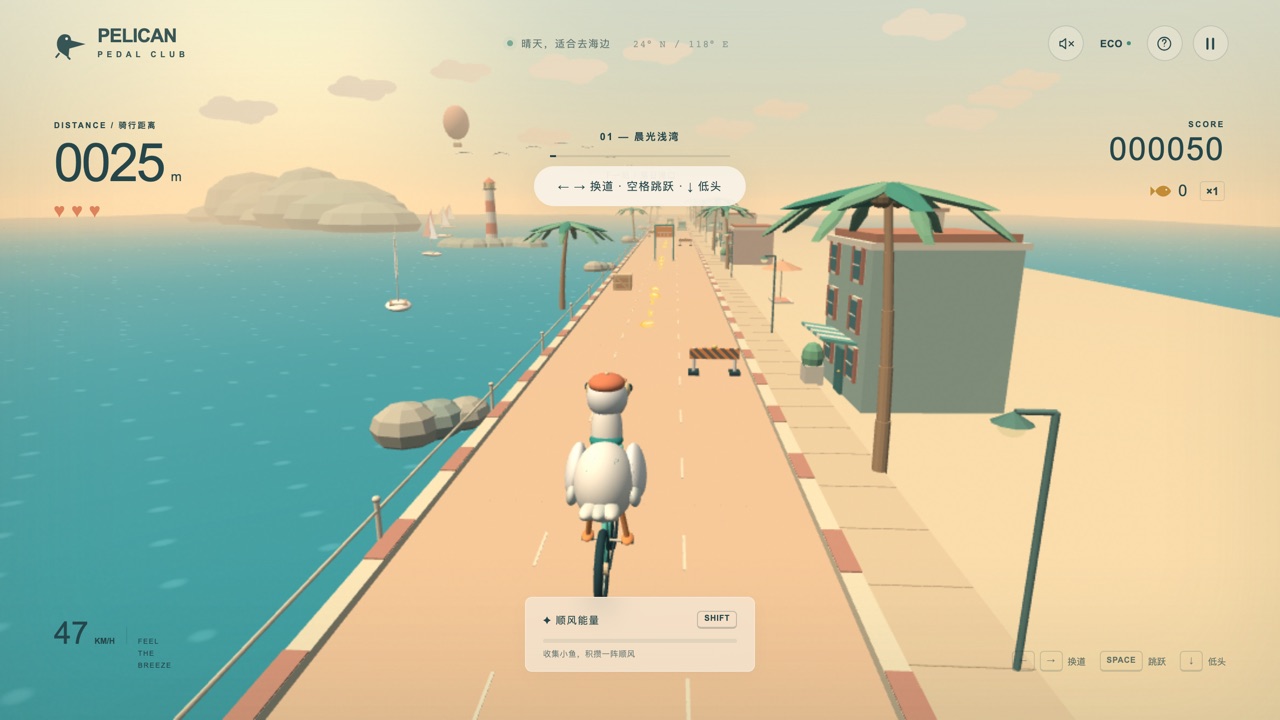
A white pelican in a helmet and a red scarf pedals a retro bicycle along an endless 3D coast, catching fish in its beak. There is nothing to crash into and no way to lose: you steer across the road for the fish, work through fourteen small achievements, and watch a real sunset turn into a starry night. It is not the same program as PELICAN PEDAL, this site's other pelican-on-a-bicycle game — the two share a subject and no code.
鹈鹕骑单车 ("Pelican on a Bike") is a coastal bike ride you cannot lose. A white pelican in a helmet, sunglasses and a red scarf pedals a retro bicycle with a wicker basket down a seaside road that never ends, and fish hang in the air ahead of it, one at a time, in one of four positions across the road. You steer into them and the pelican swallows them whole. There is no timer, no health, no score, nothing to crash into and no game over anywhere in the code — the only numbers that go up are a fish tally and a list of fourteen small achievements.
What holds the attention instead is the world. The sun moves on a real elevation model, so the sky, the fog, the water colour and the bloom all change together; left alone the clock runs a full day in about sixteen minutes, and you can also drag it to any hour, freeze it, or push it forward three hours at a time. At night the street lamps come on and lay warm bands across the sea, the stars come out, the pelican's sunglasses come off, and the drums drop out of the music. Five cameras — free orbit, chase, a side tracking shot, a cinematic one and the pelican's own point of view — are a row of buttons at the top, and a settings panel lets you change the cruising speed, the cloud cover, the wave height, the fog and whether the bird wears a helmet at all.
It is one 800 KB HTML file with Three.js and everything else built into it: no textures, no models, no audio files, no fonts, no analytics. We watched the network the whole way through four sessions, on a desktop and in an emulated phone, and the page made exactly one request — for itself. Nothing is saved either: there is no localStorage call in the file, so a reload puts you back at zero fish and 0/14. The interface is entirely in Simplified Chinese.
This is not the same program as PELICAN PEDAL, the other pelican on a bicycle in this collection, and the difference is worth stating plainly because the one-line summaries sound identical. We opened both and compared the files. PELICAN PEDAL is about 90 KB of hand-written WebGL with its own shader compilation, drawn in flat pastel, and it is a three-lane endless runner: crates and barriers to jump and duck, three hearts, a score, a personal best and a tailwind meter to spend. This one is 800 KB with Three.js r186 bundled inside, rendered with physically based materials and post-processing, and it has no obstacles and no way to fail at all. The two files share no lines of code longer than a few words and no identifiers beyond the ones every WebGL page uses. They are two different answers to the same picture.
How to play 鹈鹕骑单车 · Pelican on a Bike
- The scene is already running behind the title card when the page opens, on the cinematic camera. 开始骑行 ("start riding") begins with sound; 静音进入 ("enter muted") begins without it — and it really does mean without, since the page does not create an audio context at all until you take the first of those two buttons.
- W or the up arrow pedals harder, S or the down arrow brakes, and letting go settles back to a cruise of about 27 km/h. A and D, or the left and right arrows, steer left and right across the road — smoothly, not in snapped lanes — and the bicycle leans into the turn. Space jumps, and T takes both wings off the handlebars, spreads them and lifts the front wheel. Top speed is about 56 km/h.
- Leave the steering alone for four seconds and it takes over: the bike drives itself to the next fish within forty metres and keeps collecting while you do something else. The gearbox is automatic too — it aims for a cadence around 86 rpm and shifts when you drift above 102 or below 68 — but Q and E take manual control of the five gears, and it stays out of your way for eight seconds afterwards.
- Fish arrive one at a time, every sixteen to thirty-four metres, at one of four positions across the road. Roughly one in eight is gold and counts as five. The achievement counter in the corner tracks fourteen of them: your first fish, a gold one, ten fish, fifty fish, a first jump, a trick, three tricks, 30 km/h, 45 km/h, one kilometre, five kilometres, riding at night, ringing the bell ten times, and making the pelican squawk. Riding without much thought we had eight of them inside a minute.
- The rest is scenery controls. C cycles the five cameras, or click their names at the top; drag to orbit and scroll to zoom, and dragging while a fixed camera is running switches you to the free one. The clock slider under the fish count sets any hour of the day, the ⏯ beside it freezes time, and N jumps three hours forward. B rings the bell, H makes the pelican squawk, U hides the whole interface, P pauses, F is fullscreen, M turns the music off. Clicking works too: the pelican squawks when you click it, the bell rings when you click it or the bike, and clicking the open sea makes a fish leap out of the water.
- On a phone the page adds its own pad: ◀ ▶ on the left for steering, ▲ ▼ on the right for throttle and brake, and 🔔 🪽 ⤒ above them for bell, trick and jump. The camera row, the settings panel and the clock slider all stay. Everything we tried there worked, including tapping the bird to make it squawk.
Controls: W / S or the up and down arrows pedal harder and brake; A / D or the left and right arrows steer smoothly left and right across the road; Space jumps; T is a no-hands trick; B rings the bell; H makes the pelican squawk; Q and E change gear by hand; C cycles the five cameras; N pushes the clock forward three hours; M turns the music off; K saves a screenshot; F is fullscreen; U hides the interface; P pauses. Drag to orbit and scroll to zoom. Clicking the pelican makes it squawk, clicking the bell or the bike rings it, and clicking the open sea makes a fish jump. On a phone, on-screen buttons: left and right, throttle and brake, jump, trick and bell.
Click Fullscreen above the game for the largest play area. If the game does not load, use Open in new tab to play it directly from our copy.
Why it's worth your time
The technical claims on its own title card are true, which is not something to take for granted. We read the code for each one. The waves are Gerstner waves: there is a gerstner() function in the water's vertex shader that displaces each vertex along a wave direction and hands back a tangent and binormal, called several times per vertex for a summed wave train, with the phase computed in double precision on the JavaScript side so the surface does not start jittering after a long ride. The pedalling is inverse kinematics: one two-bone solver — the law of cosines, with a pole vector to decide which way the joint bends — runs four times a frame, once for each leg from the hip to the pedal it is standing on, and once for each wing from the shoulder to the handlebar grip, which is why the feet stay stuck to the pedals and the wingtips to the bars through every lean and bounce. The scarf is a real cloth strip, not an animation: sixteen segments of two particles each, integrated Verlet-style from their previous positions, two substeps and four passes of distance constraints per frame, pinned at the knot, blown by the bike's own velocity plus a per-segment flutter, and pushed back out of a sphere around the pelican's body so it does not sink into the bird.
The music is generated while you ride, and it follows your legs. There are no audio files in the page. A Web Audio graph is built from scratch — a compressor on the master bus, a convolver reverb whose impulse response is synthesised on the spot, and looping white- and brown-noise buffers filtered into wind, tyre roll and surf that rise and fall with your speed. Over that runs a sixteen-step sequencer through four chords, with triangle-wave pads, a sine bass, an arpeggio and noise-built kick, snare and hats. Its step length is sixty seconds divided by your cadence divided by four, so the tempo is literally your pedalling speed, and every other step is stretched slightly for swing. Past a certain darkness the percussion stops and only the pads and bass are left. Muting the tab mutes the audio, and the ⚙️ panel has separate master and music volumes.
The day is a sun, not a colour fade. The page computes a sun direction and a moon direction for the hour, takes the sun's elevation angle, and drives the sky gradient, the fog density, the exposure, the bloom strength and threshold, the cloud tint, the water colour and the street lamps from that one number. On the hour slider you can watch the headlight and the lamp reflections come up, the stars appear and the wave crests lose their sunlit translucency. The pelican's sunglasses are set to "auto" and come off by themselves once it is dark enough.
It manages its own frame rate. It reads the pointer type on load and starts at "精美" (high) with a mouse or "均衡" (balanced) on a touchscreen, then watches the frame rate: four slow frames in a row and it drops the render resolution by 0.2, sixteen good ones and it puts 0.1 back, with a floor at 0.6 and a memory of the setting that went wrong. We watched it happen — the little readout went from 1.00x to 0.80x and the canvas from 1280 by 720 to 1024 by 576 — and it is the reason the page stays smooth rather than stuttering. The quality can also be pinned in the ⚙️ panel or with a ?q=low|medium|high|ultra in the address.
Small things it does not advertise. The 🔗 button copies a link with the current hour and camera in it, so a share reopens on the same sunset from the same angle. 📸, or K, saves a PNG of the frame. The ⚙️ panel goes well past graphics: cruising speed in metres per second, the autopilot and the automatic gearbox as switches, the speed of the day in hours per second, cloud cover, wave height, fog density, and toggles for the helmet, the sunglasses, the scarf and whether the bird's eyes follow your mouse. The address bar accepts ?time=, ?cam=, ?speed=, ?dayrate=, ?freeze=1, ?fps=1 and ?autostart=1.
What it is not. There is no obstacle, no collision, no damage, no lives, no timer, no score and no leaderboard anywhere in the file, and nothing is written to the browser, so there is no progress to come back to. It is a toy you ride for as long as you feel like riding, and the achievements are the only thing resembling a goal.
About our copy, and about the original. The page carries no analytics, no fonts and no CDN calls, so nothing had to be blocked: our copy is the same file with this site's usual script for keeping URLs inside the mirror, and one rewritten line — the og:image meta tag, which points at a picture on the original host that the page itself never loads. Everything else is byte for byte the original, and it runs with the network off, which we checked: 33 fish and nine achievements in one offline session, no errors, and the only request it made was for itself. One detail worth recording: the identical file — byte for byte, apart from the one og:image line that names its own host — is also served from a Cloudflare Pages site whose name credits Claude Opus 5.5, posted to a Chinese forum on 23 September 2026 with the claim that a single prompt produced it in one pass. We cannot confirm that. The copy we link to is on a ByteDance CDN and its last-modified date is about seven hours older than that post, the page itself names no author, model or licence, and we found nothing else, so this entry does not say who made it or with what.
How it was made and where it lives
Hosted on the author's own page. Original: https://lf3-static.bytednsdoc.com/obj/eden-cn/nulojnulwlo/pelican-bike/index.html. The Play button above runs our own unmodified copy, so the game keeps working here if that page goes down — which on free hosting usually has nothing to do with the author. Nothing about the game itself is changed, and the original stays linked from every page.
If you like 鹈鹕骑单车 · Pelican on a Bike, try these
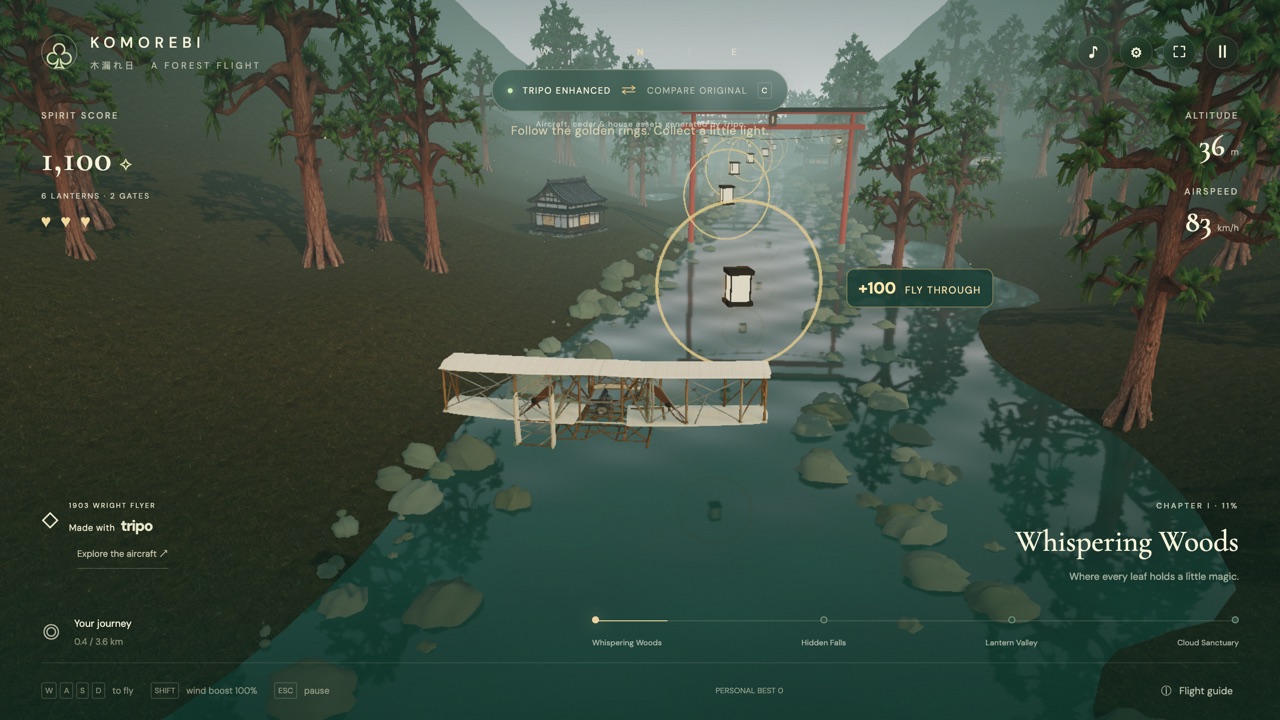
PELICAN PEDAL is this site's other pelican on a bicycle, and a genuinely different game: a flat-shaded three-lane endless runner with crates to jump, barriers to duck, three hearts and a score, where this one has no obstacles and no way to lose. Worth playing back to back. For another ride that carries you along a hand-made landscape while you look around, Komorebi: A Forest Flight flies a 1903 biplane down a misty Japanese river.
Frequently asked questions
- Is this the same game as PELICAN PEDAL?
- No. They share a pelican on a bicycle by the sea and nothing else. PELICAN PEDAL is a 95 KB hand-written WebGL endless runner in flat pastel, with crates, barriers, three hearts, a score and a personal best. This is an 800 KB Three.js scene with physically based lighting, a real day-night cycle, five cameras and no obstacles at all. We compared the two files: no shared code.
- Can I lose?
- No. There is nothing to hit, no health and no timer. The only things that move are the fish count and the fourteen achievements.
- Does it save my progress?
- No. The file makes no use of browser storage, so a reload starts again at zero fish and 0/14.
- Does it need an internet connection?
- Only to load. Everything — the 3D library, the models, the sound — is inside the one file, and after it loads the page makes no further requests. This site's copy runs with the network off.
- Is there sound, and does it start muted?
- There is sound, and it starts on unless you choose 静音进入 on the title card, which skips the audio altogether. M and the ⚙️ panel turn the music off afterwards. The music is synthesised as you ride and its tempo follows your pedalling.
- Does it work on a phone?
- Yes. It lays out its own on-screen pad and the whole interface reflows without overflowing, in portrait and landscape, and it quietly drops to its balanced quality setting on a touchscreen. It is still a heavy 3D page, so an older handset may struggle; we tested an emulated iPhone, not a real one.
- Is it in English?
- No. Everything on screen is in Simplified Chinese. The controls are single letters and the buttons are icons, so it is usable either way, and this page lists what each one does.
- Who made it, and with what?
- We could not establish either. The page names no author, no tool and no licence, and the two hosts that serve it say nothing on the record. We have not repeated what we could not check.
- Is 鹈鹕骑单车 · Pelican on a Bike free to play?
- Yes. Everything on Floating Arcade is free, with no account, ads or downloads.
- Can I embed this game on my own website?
- Yes — copy the snippet below. The embedded player links back here, which is how we ask to be credited.
Embed 鹈鹕骑单车 · Pelican on a Bike on your site
Paste this where you want the game to appear: