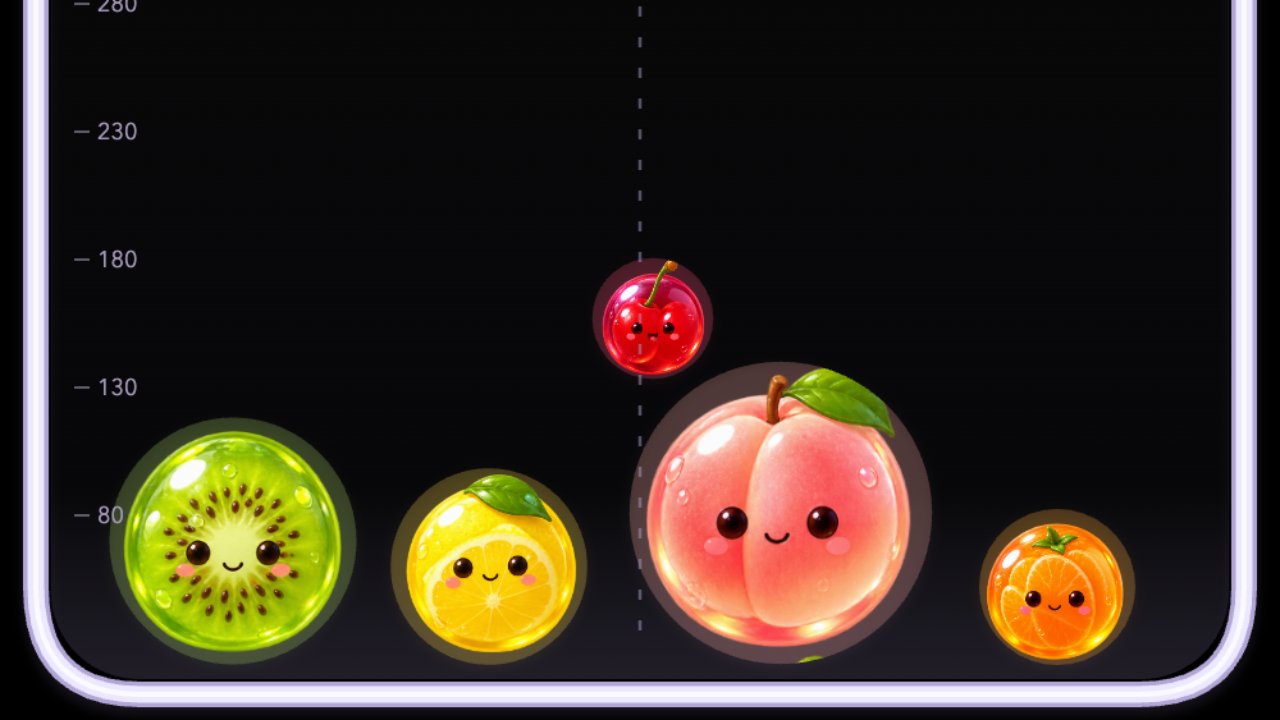
A Suika-style fruit merger built around real soft-body jelly physics — fruit compresses, rebounds and jiggles instead of colliding like rigid circles. Its own twist on the genre is 揉软一下 (soften): spend juice energy to loosen friction in a stuck stack and wiggle a fruit through the gap, rather than adjusting overall fluidity the way this collection's other watermelon game, Melon Lab, does.
Melon Club — its full on-page title is "软西瓜 · 果冻工坊 · 挑战版" (Soft Watermelon · Jelly Workshop · Challenge Edition) — is a Suika-style fruit-merging puzzle: drop fruit into a narrow jar, match two of the same tier to advance up an eleven-step chain from blueberry to watermelon, and don't let the pile cross the line near the top. What sets it apart from the genre standard is that every fruit is a soft body rather than a rigid circle — it compresses, rebounds and jiggles on impact, with tangential friction between pieces that are resting against each other, not just simple stacking.
The game's own signature move is 揉软一下 ("soften"), reachable by clicking the button, tapping it on a touchscreen, or pressing Space. It spends from a shared "juice energy" pool to temporarily cut the friction between stacked fruit for about 2.4 seconds, so a piece wedged in a gap can be nudged loose and slide down to find its match — the practice scene bundled with the tutorial puts it plainly: "体积没消失,只是换了个形状" (the volume isn't lost, it just changes shape). Tilting the whole pool left or right, with A/D or the on-screen 左倾/右倾 buttons, draws from the same energy pool at 10 a second, and every merge refunds +2 — so softening is a resource to spend deliberately, not a free undo.
It's built and published by a single GitHub author, threerocks (their GitHub profile lists the name Lei Liu), as one self-contained index.html with every asset — fruit art, sounds, fonts — inlined in the file. We fetched the live page directly to check: it's a single ~2.9 MB HTML document with no external script, stylesheet, font, image or analytics request of any kind, which made mirroring it about as simple as this site's tooling gets. The README (in Chinese) describes the project as at version "V6," with a changelog of physics and rendering tuning — this entry calls out only what we could verify by actually playing it, not the implementation details we had to take on faith.
This is not the same game as this collection's other watermelon-merge entry, Melon Lab. Melon Lab's fix for a stuck stack is a fluidity dial and a stir button that loosen the whole pool at once; Melon Club's is the soften move described above, a deliberate, costed action aimed at one trouble spot rather than a global setting.
How to play Melon Club
- Drag left and right (or use the left/right arrow keys) to aim the falling fruit, then release, click, or press Enter to drop it. Dragging the fruit back out over the jar before releasing cancels the drop instead of placing it.
- Two fruit of the same tier touching merge into the next tier up: blueberry → grape → cherry → orange → lemon → apple → kiwi → peach → coconut → cantaloupe → watermelon. The next fruit is always drawn from the first five tiers, so you're never blindsided by a huge piece.
- When a small fruit gets stuck in a gap it can't fall through on its own, click "揉软一下" (or press Space) to soften the stack for about 2.4 seconds and wiggle it free. It costs 60 energy from the shared juice-energy meter (which starts partway full, at 60 of a 100 maximum); each merge refills +2, and holding a tilt button drains 10 a second from the same pool, so tilting and softening compete for the same resource.
- The 慢镜头 (slow-motion) button in the top bar opens a separate physics lab, unrelated to your live match: three canned scenarios — a single fruit landing, a size-mismatched collision, and two same-tier fruit merging — play back on a scrubbable timeline with 1× and 0.25× speed, a pause, and a "+1 frame" button that steps exactly 1/60 of a second at a time. Turning on "显示真实节点" (show real nodes) overlays each fruit's live width, height and aspect ratio in logical pixels as it compresses and rebounds — a genuinely dev-grade instrumentation view, not just a slow-down toggle.
- The tutorial's last hint, "看看怎么挤过去" (see how it squeezes through), opens a standalone softening-practice scene the game explicitly labels as not affecting your current match: a fruit stuck between two fixed obstacles that you soften to watch squeeze through and drop down to its partner.
- Merging two cantaloupes produces the watermelon, the top of the chain, and it behaves differently from every merge before it: the game's own win screen says so directly — "这颗大西瓜,属于你合出来了!...还可以继续冲分。西瓜会留在果池里,不会消除。" (This big watermelon is yours! ...You can keep pushing your score — the watermelon stays in the pool, it won't disappear.) There's no "you win, game over"; you keep dropping fruit and scoring around it.
- A round ends when the pile stays stably above the red line near the top of the jar for 3 seconds. The end screen we triggered to verify this offers a concrete tip in its own words: "下次试着把大水果放在一侧,别把小水果埋在底下" (next time try keeping big fruit to one side, and don't bury small fruit underneath).
Controls: Drag or the left/right arrow keys aim the falling fruit; release, click, or Enter drops it. Hold the on-screen 左倾/右倾 (tilt) buttons or A/D to rock the whole pool, and tap or press Space for 揉软一下 (soften) to loosen friction between stacked fruit for about 2.4 seconds so a stuck one can be nudged into a gap. Both tilting and softening draw from one shared juice-energy meter (tilting drains 10/second, softening costs 60 outright, each merge refills +2), so it's a resource to spend, not a free undo.
Click Fullscreen above the game for the largest play area. If the game does not load, use Open in new tab to play it directly from our copy.
Why it's worth your time
We downloaded the live page directly rather than trusting the README's "all resources inlined" claim: it's genuinely one HTML file, about 2.9 MB, with zero outbound requests of any kind — no separate script, stylesheet, font, image, or tracker. That made this one of the simplest mirrors on this site: the only difference between the original bytes and what's served here is this site's own injected script that keeps root-relative URLs inside the mirror, which this game never even calls.
The shipped file contains a hidden QA harness that's only reachable by adding ?qa to the URL — a normal visitor never sees it. Doing so reveals a "验证记录" (verification log) panel with buttons for a 40-fruit rendering-stress scene, a large-fruit transparency check, an autoplay mode, and instant jumps straight to the win and game-over screens, plus a live JSON diagnostics readout. We used it (openly, via the documented query parameter, not by reverse-engineering anything hidden) to confirm the watermelon-persistence and game-over copy quoted above without having to grind out a full session by hand — worth flagging as the kind of developer tooling that occasionally ships by accident in a single-file project, not part of the intended play experience.
The slow-motion lab's frame-by-frame width/height readout is real evidence for the soft-body claim, not just marketing copy: watching two same-tier fruit approach and merge one frame at a time, each one's own aspect ratio visibly departs from 1.0 on impact and settles back — an actual deformation being measured, not a squash-and-stretch animation trick.
The GitHub repository (threerocks/melt-melon) lists no LICENSE file in its contents as of this writing, and has had no formal releases — reuse rights beyond "read the public source" are unclear, so treat the code as the author's own unless they say otherwise.
Most of this entry comes from actually playing the page rather than repeating its README: we dropped fruit, worked the aim and tilt controls, stepped through the slow-motion lab frame by frame, ran the standalone softening-practice scene end to end (watching a stuck fruit visibly change shape and squeeze through a gap), and used the game's own documented ?qa shortcuts to reach and read the win and game-over screens verbatim. One exception, in the interest of not overclaiming: the exact energy costs and refill amounts (60 to soften, 10/second to tilt, +2 per merge) are quoted from the control panel's own on-screen labels rather than independently re-measured by draining the meter ourselves, since our synthetic input in this session's Browser-pane tooling didn't reliably reproduce a held key or button press.
How it was made and where it lives
Published on GitHub Pages from a public repository. The author publishes as threerocks. Original: https://threerocks.github.io/melt-melon/. The Play button above runs our own unmodified copy, so the game keeps working here if that page goes down — which on free hosting usually has nothing to do with the author. Nothing about the game itself is changed, and the original stays linked from every page.
If you like Melon Club, try these
Melon Lab is this collection's other watermelon-merge game, with a different core mechanic: a fluidity dial and a stir button that loosen the whole pool, instead of Melon Club's costed, targeted soften move.
Frequently asked questions
- Is this a Suika Game clone?
- It's the same eleven-tier merge idea as every watermelon game, but built around soft-body jelly physics — fruit compresses and rebounds instead of colliding as rigid circles — plus a signature soften move for unsticking a jammed stack.
- How is this different from Melon Lab, this site's other watermelon game?
- Melon Lab gives you a fluidity dial and a stir button that loosen the whole pool at once. Melon Club instead has a costed, targeted "soften" action that spends juice energy to loosen friction around one stuck fruit — a different mechanic, not just a different skin.
- What happens when I merge a watermelon?
- It stays in the pool rather than disappearing — the game's own win screen says so directly — and you keep dropping fruit to push your score higher around it.
- Does it work on a phone?
- Yes. The whole layout — the jar, the tilt and soften buttons, the merge-chain strip — reflows cleanly to phone width with no overflow, verified with this site's own mobile check. A tap on the jar aims and drops a fruit the same way a click does.
- Can I reuse the code?
- The GitHub repository doesn't include a LICENSE file as of this writing, so its reuse terms aren't stated — treat it as the author's own unless they say otherwise.
- Is Melon Club free to play?
- Yes. Everything on Floating Arcade is free, with no account, ads or downloads.
- Can I embed this game on my own website?
- Yes — copy the snippet below. The embedded player links back here, which is how we ask to be credited.
Embed Melon Club on your site
Paste this where you want the game to appear: