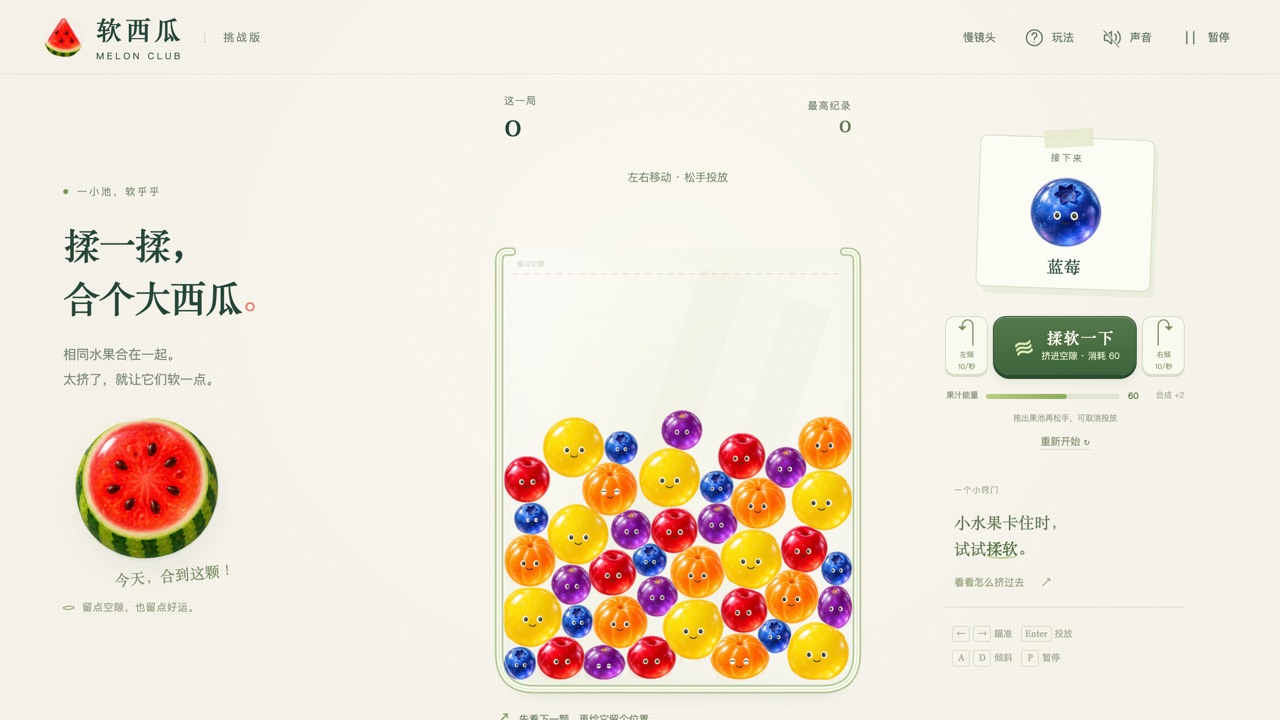
Let fruit squish, deform and merge like jelly. Adjust the fluidity, stir the pool, and merge your way to a giant watermelon.
Melon Lab is a merge game with a twist: the fruit are soft. Instead of rigid circles, each piece squishes, deforms and slides against its neighbours like jelly, and you can turn a fluidity dial to make the whole pool looser or stiffer. Drop matching fruit together and they combine into the next size up; the goal, as in every watermelon game, is to build the biggest melon before the container overflows.
It was published through ChatGPT Sites by jack-514 and, once loaded, runs entirely in the browser. The version here is a complete mirror of the game's files.
How to play Melon Lab
- Move the cursor (or your finger) left and right to choose where the next fruit drops, then click or tap to release it.
- Two identical fruit that touch merge into the next fruit in the chain. Bigger fruit take more space, so plan where they land.
- Use the fluidity slider to change how much the pieces deform. Looser pools settle more but are harder to predict.
- The stir control shakes the pool — useful when pieces wedge in a way that blocks a merge.
- The game ends when fruit pile over the top line.
Click Fullscreen above the game for the largest play area. If the game does not load, use Open in new tab to play it directly from our copy.
Why it's worth your time
Unlike most of the ChatGPT Sites games here, Melon Lab is not a single file: the page loads a stylesheet, a game script, a separate physics module (an ES module the game imports) and one sprite sheet for the fruit — just under 2 MB in total, nearly all of it that sprite sheet. We mirror all five files together, so the game runs from this site with nothing fetched from the original host.
The soft-body simulation is the whole point. Most browser merge games use rigid-body physics; this one solves each fruit as a deformable blob, which changes how stacks settle and makes the 'stir' mechanic possible.
How it was made and where it lives
Published through ChatGPT Sites (chatgpt.site) — the same hosting pipeline GPT-6 Astra uses to ship playable games straight from a prompt. The author publishes as jack-514. Original: https://melon-game.jack-514.chatgpt.site/. The Play button above runs our own unmodified copy, so the game keeps working here if that page goes down — which on free hosting usually has nothing to do with the author. Nothing about the game itself is changed, and the original stays linked from every page.
ChatGPT Sites is the hosting side of the workflow OpenAI describes for building games with GPT-6 Astra: the model writes the game, then publishes it to a public address in one step. That is why so many of the newest single-file browser games are appearing on chatgpt.site domains.
If you like Melon Lab, try these
Melon Lab and Mosswing are by the same author, jack-514, and share the same approach: one input, one file, tuned for a phone. If you want physics with more chaos, Doodle Shooter is a full movement shooter; if you want the opposite, Infinite Garden makes gravity itself the puzzle.
Melon Club is this collection's other watermelon-merge game, and it's soft-body too — but where Melon Lab hands you a fluidity dial and a stir button, Melon Club's fix for a jammed stack is a dedicated soften move that spends a juice-energy resource to loosen friction between stacked fruit.
Frequently asked questions
- Is this the same as Suika Game?
- It is the same merge idea, but with soft-body fruit and adjustable fluidity rather than rigid circles.
- Does it work on a phone?
- Yes, it is touch-friendly.
- Can I play offline?
- Yes — once the page has loaded it needs nothing from the network.
- Is Melon Lab free to play?
- Yes. Everything on Floating Arcade is free, with no account, ads or downloads.
- Can I embed this game on my own website?
- Yes — copy the snippet below. The embedded player links back here, which is how we ask to be credited.
Embed Melon Lab on your site
Paste this where you want the game to appear: