You are a little clay figure pushing a 6 cm five-colour stone. Anything smaller than the ball sticks to it and makes it bigger, starting from melon seeds and mahjong tiles and, the README says, working up through cats, buses and apartment blocks to whole mountains, until you can fly up and plug the hole Nüwa knocked in the sky. An unofficial fan game paying homage to Katamari Damacy, in Chinese. The README says Claude Code (Claude Opus 5.5) built it from a one-sentence request.
万物皆可滚 (Wànwù jiē kě gǔn, roughly "everything can be rolled"; the English name here is ours, the game has none) is a 3D game about a ball that grows. The subtitle on the title screen is 女娲补天, "Nüwa mends the sky". In the story, the goddess Nüwa of Chinese myth got carried away smelting five-colour stones and knocked a hole in the sky. You are a little clay figure she has just made, and she gives you one of those stones, 6 centimetres across, to push. Anything smaller than the ball sticks to it and makes it bigger; anything bigger bounces you off until you have grown.
The README's list of what you will roll up runs from melon seeds and mahjong tiles through cats, square-dance aunties, delivery riders and buses to apartment blocks, a TV tower (明珠塔), a high-speed train, and finally mountains and clouds, after which the ball flies up to fill the hole. We played the first minute or so, up to about 11 centimetres, so what we can describe from our own play is the plaza at the start: a red-brick square strewn with seeds, coins, peanuts, marbles, bottle caps, keys and rubbers, and, on the title screen behind the menu, a low-poly street of housing blocks, trees and small figures under a purple hole in the sky.
It is a fan game, and says so twice: the title screen's small print and the README both call it an unofficial fan work paying homage to Katamari Damacy (块魂 in Chinese) and the README adds that it contains none of the original's material. We have not compared it with that series and claim no connection to it. The whole interface, the story and Nüwa's speech are in Chinese, with no language switch.
It is by the GitHub user superdiaodiao, at github.com/superdiaodiao/wanwu-gun, and the repository is dated 23 to 24 September 2026. Its README ends by saying the whole project was designed, written and tested by Claude Code (Claude Opus 5.5) from a one-sentence request. That is the author's own statement, in the README since the first commit on 23 September 2026, and all 12 commits carry a "Co-Authored-By: Claude Opus 5.5" line, which is why this page carries the Made with Claude and Opus 5.5 tags. We can only see the finished game: not the request, the conversation or what the author changed by hand.
How to play 万物皆可滚 · Roll Everything
- The title screen has two buttons: 开始补天 (mend the sky), a timed run of 6 minutes, and 自由滚 (free roll), with no time limit. Below them are picture quality, music, sound effects and a 省电 (power saving) box. Pressing a button starts the game after about two seconds, and Nüwa talks you through the basics in a speech bubble; click, Space or Enter go to the next line and Esc skips it.
- On a keyboard, WASD or the arrow keys roll the ball in the direction you press, relative to the screen, and the camera turns to sit behind it; pressing back turns you round. Dragging the mouse turns the camera, Space dashes, C changes the camera distance, and M switches the music. On a phone you hold the left half of the screen as a joystick, swipe the rest of it sideways to turn the camera, and press the red 冲 (dash) button.
- The screen shows a ring with your size and the next target (from 6 cm the first target was 10 cm, then 20 cm), a count of things rolled up, a card with the last thing you picked up, a round minimap that turns with the camera, and Nüwa's comments. When we passed 10 cm a big "10 cm!" appeared with a line listing what you can now roll up (eggs, garlic, butterflies), and Nüwa said the seeds and coins had stuck. Things you can roll have a gold edge and things still too big have red stripes, according to the README, and the commit notes describe a red "cannot roll, needs 2.7 m" tag over something you are about to hit. We did not run into anything too big.
- Esc or P pauses and shows a map of the whole world, with the mountains, the high-speed rail and the city districts marked, and your trail. In the timed mode the README says the day runs from morning to dusk over the 6 minutes, and when time is up the ball flies up to patch the sky and Nüwa gives you a title by size, from 小泥丸 (little clay pill) up through 泥球, 石球, 巨石, 补天石 and 五色神石 to 开天辟地. In free roll, the pause screen has a button, 现在就去补天 (go and mend the sky now), that ends the run whenever you like.
- We used that button after 46 seconds and 12 things picked up, and within about 20 seconds a results card came up over a night sky (we did not watch the finale in between). It showed the final size (11 cm), the title 小泥丸, a teasing line from Nüwa (roughly, "is that all? you could not even patch a pinhole"), the time, the biggest thing rolled (a mahjong tile, 2.6 cm), the longest combo, the number of things dropped, a list of what was collected, and a button that copies a sentence about your result. Buttons offer another run, carrying on in free roll, or going back to the title.
Controls: Desktop: WASD or the arrow keys roll the ball the way you press, relative to the screen, and the camera swings round behind it; dragging the mouse turns the camera; Space dashes; C changes the camera distance; Esc or P pauses and shows a map; M switches the music. During Nüwa's opening speech, click, Space or Enter go to the next line and Esc skips it. Phone: hold the left half of the screen as a joystick, swipe the rest of the screen sideways to turn the camera, and press the red 冲 button to dash. The title screen also has settings for picture quality (high, medium, low), music, sound effects and power saving.
Click Fullscreen above the game for the largest play area. If the game does not load, use Open in new tab to play it directly from our copy.
Why it's worth your time
Where this copy comes from. The original is a GitHub Pages site, https://superdiaodiao.github.io/wanwu-gun/, and when we checked on 24 September 2026 it was identical to the repository's page at its latest commit (498a00a). The page itself is 30 KB, and the game is one separate 1.2 MB script beside it. Visitors whose time zone is China's load that script from a Tencent Cloud storage bucket first, and everyone else loads it from the page's own site, each falling back to the other. Our copy holds the page, the script and the fonts, 190 files and about 10 MB, and needs none of those addresses. The address stays linked as the original.
What we changed in it, exactly. The game builds the address of its Google Fonts style sheet while it runs, so our usual rewriting cannot see it and a plain copy would have asked Google for fonts on every visit. We changed that one string in the script (1,183,408 bytes became 1,183,278) so that it reads the style sheet and font files we saved instead; everything else in the script is the original, byte for byte. The saved fonts are the five families it asks for (Baloo 2, Ma Shan Zheng, Noto Sans SC, Noto Serif SC and ZCOOL KuaiLe), as served from fonts.googleapis.cn, and we kept every piece that covers a character appearing in the game's script or page. We did not check each font's licence. A file beside the copy lists these changes.
The licence, plainly. The repository has no licence file, in any of its 12 commits, so we do not call it open source: the code is public and the game is free to play, but nothing says what you may reuse, and the README does not either. Our copy therefore exists on the author's goodwill and not on a permission. If superdiaodiao would rather we linked to the original than hosted it, the address in the footer reaches a human and the copy comes down.
What it made of. The README says there are no image, model or audio files: all 238 models are put together in code out of low-poly shapes, text and pictures are drawn onto one texture sheet at start-up, and the music and effects are made live with the browser's audio (the README says the score is original, with the zither played by a plucked-string algorithm). We saw that in our copy: apart from the page, the script and the fonts, it requests nothing. We did not listen to the sound, so we cannot describe it. The README says it uses three.js r186, a logarithmic depth buffer so that a one-centimetre seed and a mountain can both be seen, and a simpler model for small things far away.
How it ran. In Chromium on a Mac with its own graphics chip, served locally, the title screen and the first minute of play held about 58 to 60 frames a second at 1280 by 720, with short dips while other jobs were running on the same machine (once to about 25, once to about 42). The title screen appeared about nine seconds after loading the page on that busy machine, and starting a game took about two seconds. No script errors appeared in any of our runs. Everything we saw is at the scale of small objects on a plaza, so we cannot say how it runs once the ball is the size of a bus, and we did not play the full six minutes or reach the larger stages.
Phones. In an emulated iPhone 13, upright (390 by 664) and sideways (750 by 342), the page fits with no sideways scroll and the title screen is laid out for the small screen with the power-saving box already ticked and the quality set to low (the code decides that for small touch screens). Once a game starts, a joystick and a red dash button appear. Holding the joystick up rolled the ball and it picked up five things in about eight seconds. We also swiped the right side and tapped the dash button without errors, but we did not confirm what they did. The commit notes describe fixes for iPhone problems (black or missing objects, a slow start, a hot phone), so the author has clearly been testing on phones, but we did not have a real one. An emulated phone on a desktop chip says nothing about speed on a real handset.
Saved data and other sites. The game stores five things in your browser, under keys beginning "wanwu.": picture quality, power saving, music, sound effects, and your best result (size, title and date). The code has no cookies, no analytics and sends no data anywhere. The original page loads Google Fonts (fonts.googleapis.com, or .cn from China's time zones) and possibly the Tencent Cloud bucket; the copy here makes no request to any other site, which we checked by blocking everything but our own address.
If your browser has no WebGL2 (we simulated that by refusing it), the page shows a Chinese message that the browser does not support WebGL2 and suggests a newer Chrome, Edge or Safari. The code pauses it when the tab is hidden, which we did not test. Put in a frame on another site it loads and plays, and keys reach it once you have clicked into it; clicking outside the frame does not pause it. We tried the game in a frame served from a different address than the game.
Not tried: a gamepad (the code reads one), the sound, a real phone, the full timed run, and everything past the first two size goals. Nothing about the later sizes, the ending in timed mode or the other titles above 小泥丸 comes from our play; it is the README's description.
How it was made and where it lives
Published on GitHub Pages from a public repository. The author publishes as superdiaodiao. Original: https://superdiaodiao.github.io/wanwu-gun/. The Play button above runs our own unmodified copy, so the game keeps working here if that page goes down — which on free hosting usually has nothing to do with the author. Nothing about the game itself is changed, and the original stays linked from every page.
If you like 万物皆可滚 · Roll Everything, try these
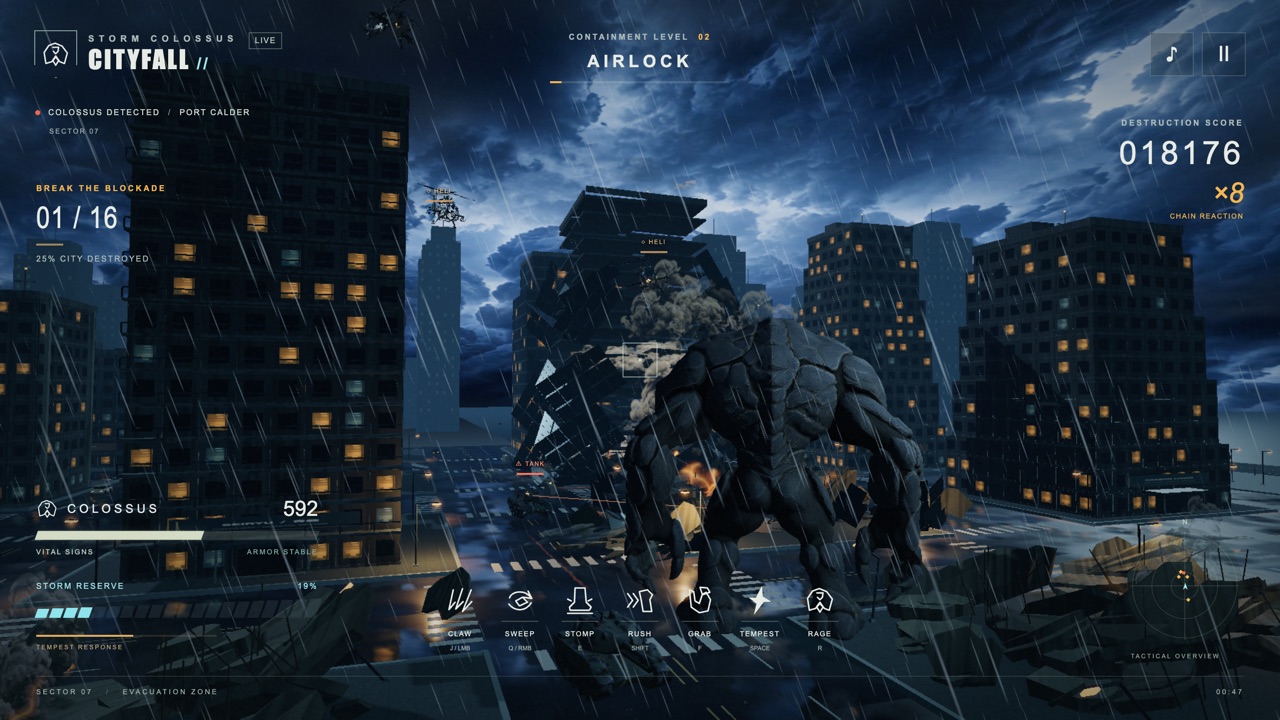
Another game about being a thing that grows and wrecks a place: Storm Colossus: Cityfall puts you in a giant's shoes in a port city. For another unofficial game paying homage to a well-known series in a very different mood, Voxel Musou - Zhao Yun is a spear fighter in the style of Dynasty Warriors, and Feiche 3D is a Chinese-language racing fan game, which is also tagged Made with Claude Opus 5.5.
Frequently asked questions
- Is it free, and do I need to install anything?
- It is free and runs in the browser. It needs a browser with WebGL2, and there is nothing to install or sign into. It is in Chinese only.
- Who made it, and was it made with Claude?
- The GitHub user superdiaodiao made it. The README says Claude Code (Claude Opus 5.5) designed, coded and tested the whole project from a one-sentence request, and all 12 commits carry a Co-Authored-By: Claude Opus 5.5 line. That is the author's own statement, published on 23 September 2026 and since. We cannot see how it was actually made.
- Is it connected to Katamari Damacy?
- No. The title screen and the README both say it is an unofficial fan work paying homage to that series and that it uses nothing from it. We have not compared the two.
- Is it open source?
- No, or at least we cannot say so. The code is public on GitHub, but the repository has no licence file, so nothing says what you may reuse. Treat it as all rights reserved by the author.
- Does it work on a phone?
- It appears to. In an emulated iPhone 13 a joystick and a dash button appear and the joystick moved the ball, and the page fits both upright and sideways. We had no real phone, so how it runs and feels there is untested.
- Can I lose?
- We did not see a way to. Bigger things bounce you off instead of hurting you, and a run ends when the timer runs out or you choose to go and mend the sky, then it grades you by size. We saw no game-over screen, but we did not play the full timed run.
- How long does it take?
- The timed mode is 6 minutes, and free roll has no limit. The pause screen in free roll has a button to end the run at any time. We ended one after 46 seconds.
- Does it save my progress or use my network?
- It saves only your settings and your best result in your browser. After loading it needs no network in our copy. The original also asks Google Fonts for its fonts, and for visitors in China's time zones it tries a Tencent Cloud bucket first for the game script.
- Why does this page play a copy and not the GitHub Pages site?
- So that it keeps working if the site or the repository goes away, and so that it does not send you to Google. The changes we made are one string in the script, as listed above. The original address stays linked.
- Is 万物皆可滚 · Roll Everything free to play?
- Yes. Everything on Floating Arcade is free, with no account, ads or downloads.
- Can I embed this game on my own website?
- Yes — copy the snippet below. The embedded player links back here, which is how we ask to be credited.
Embed 万物皆可滚 · Roll Everything on your site
Paste this where you want the game to appear: