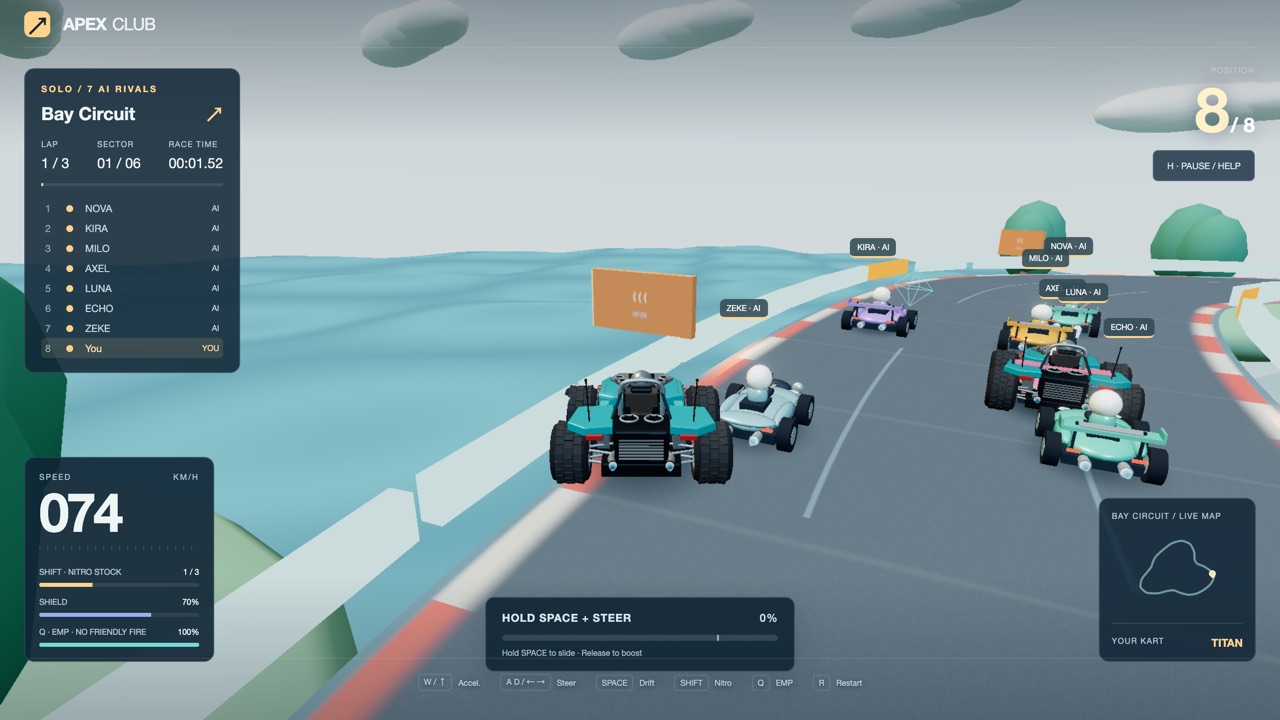
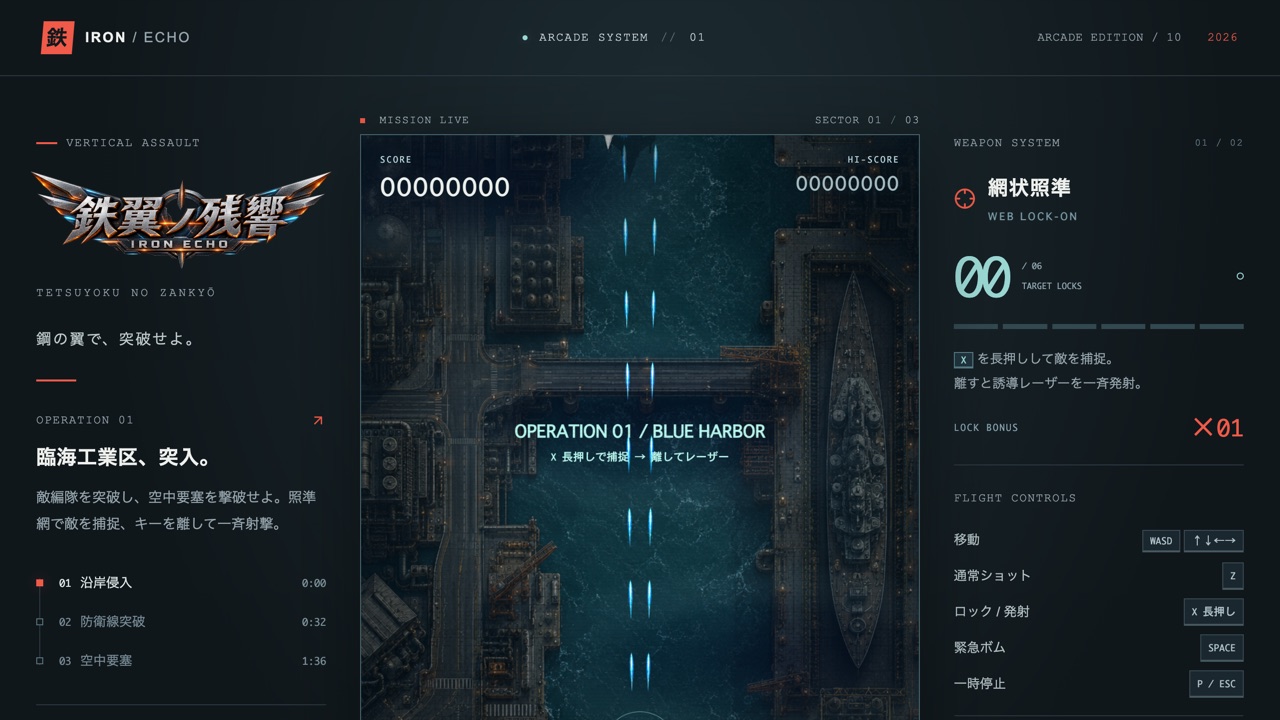
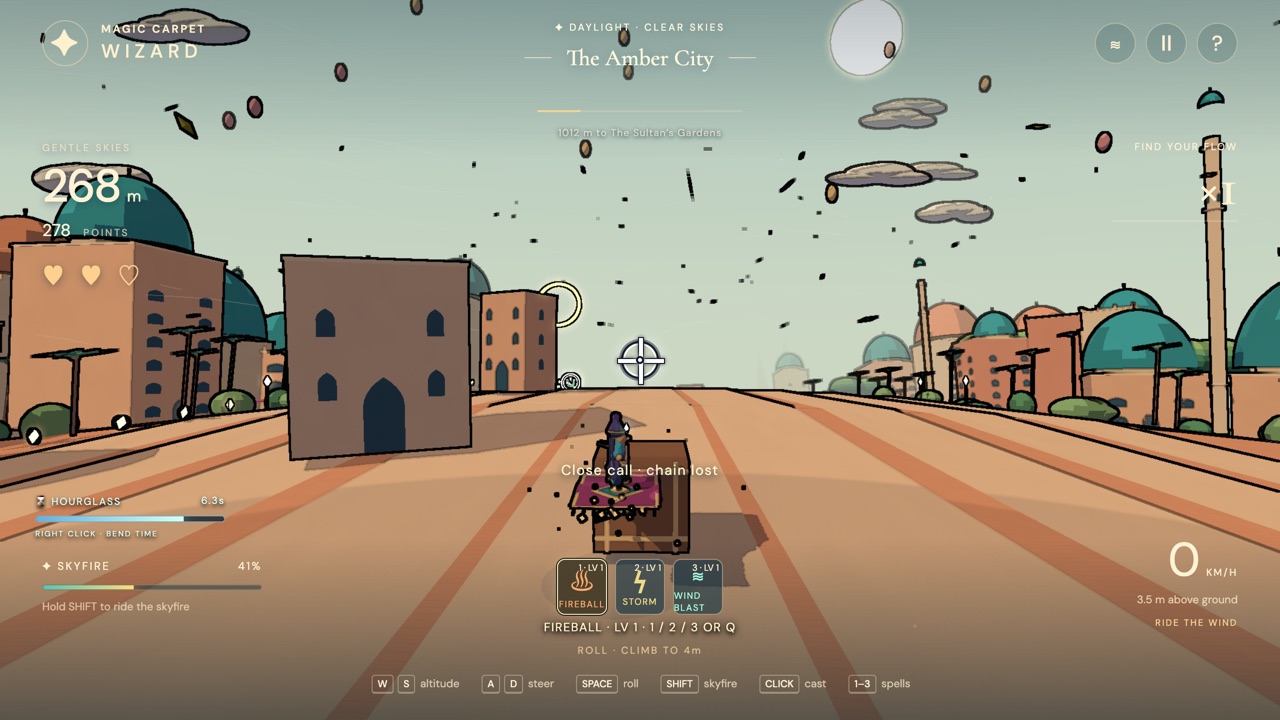
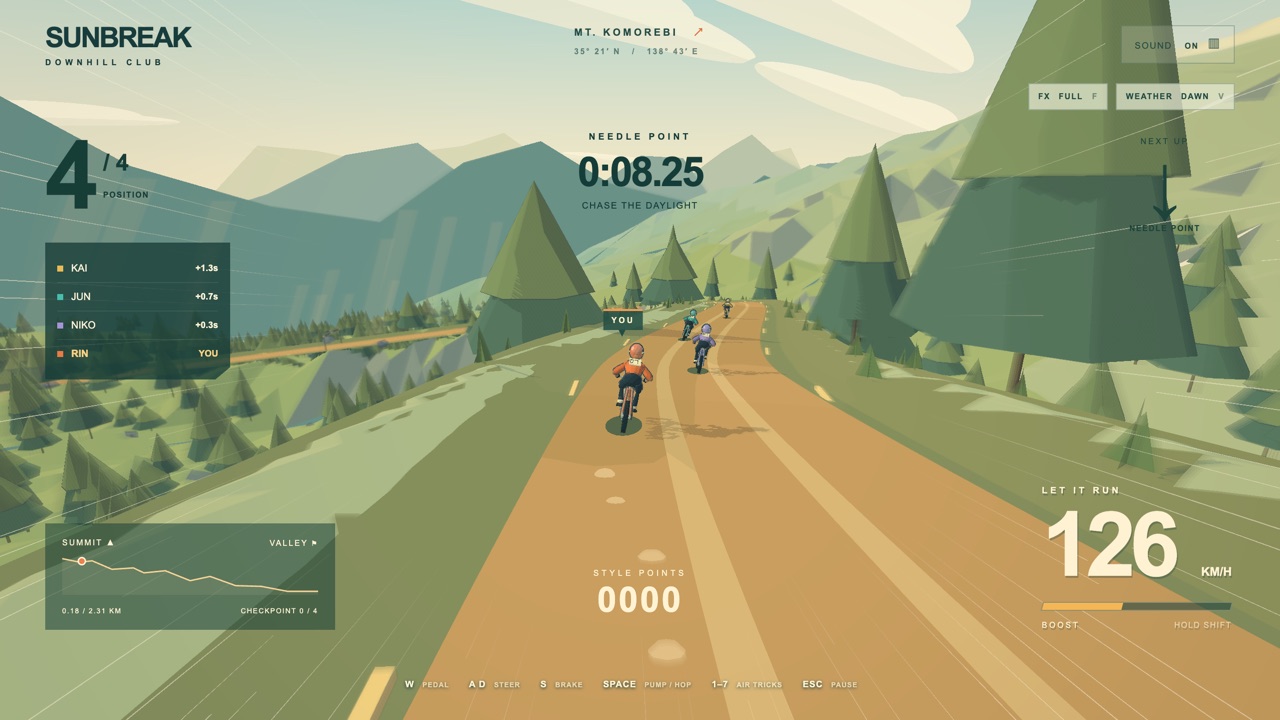
A kart race that takes place inside a pop-up book. Scenery folds up out of the page as you drive toward it, and the karts, drivers and items are made of paper and stationery. Four chapters (a daisy meadow, the Bosphorus at dusk, a glacier pass and the writing desk itself), eight animal drivers, eight items, three speed classes, a four-race Grand Prix, single races and time trials against your own ghost. The whole interface is in Turkish. The author's README says Claude Opus 5.5, in Claude Code, built it from one brief with a subagent team, and that no image, sound or font file was used: everything is generated in code.
Kâğıt Kart ("Paper Kart") is a kart racer set inside a pop-up book. You start on a wooden desk with a closed cloth-bound book and a paper fox in a paper kart parked beside it. Press a key or tap, the book opens, and each track's scenery folds up out of the page: hills, a sun, daisies and a start arch on the first chapter. The karts, the drivers and the items are all made of paper and stationery, the road looks printed, and the walls are folded card. It plays like a Mario Kart-style race: eight karts on a grid, items from floating boxes, drifting for speed boosts, three laps.
There are four chapters. Papatya Çayırı is a daisy meadow, Boğaz Gecesi is the Bosphorus at dusk with a skyline of mosques and a suspension bridge, Buzul Geçidi is a glacier pass with a drop-off to fall into, and Yazı Masası is a race across the writing desk itself. You pick one of eight animal drivers (Tarçın the fox, Nilüfer the frog, Paytak the penguin, Pofuduk the bear, Kömür the cat, Pervane the owl, Havuç the rabbit and Mürekkep the octopus), a speed class named after paper weight (80, 120 or 200 g), and a mode: a four-race Grand Prix with points, a single race against seven rivals, or a time trial against a ghost of your best lap. The whole interface is in Turkish.
It is here because of how the author says it was made. The repository is github.com/BurakErdemci/kagit-kart, by the GitHub user BurakErdemci. Its README says that he gave Claude, Opus 5.5 in Claude Code, a single brief to make a Mario Kart-like racing game in the browser at the best level it could, and to say when it thought the result was worth showing, with one rule: everything must be generated by code, with no outside assets. The README goes on to say that Claude acted as architect and subagents wrote the code, that a QA agent played the whole game and wrote up 27 issues, and that five fix rounds followed, for about 27,000 lines of JavaScript in 78 modules over the evening of 22 September to the early hours of 24 September 2026. The README section is in the repository as of 24 September 2026 (the commit that adds it is timestamped 05:10 UTC that day). We can check the size claim, but not the rest: we cannot see how the game was actually made.
How to play Kâğıt Kart
- Open it and wait a moment for "sayfalar açılıyor" ("the pages are opening"). You get the closed book on the desk and a prompt that reads "Başlamak için dokun" ("tap to start") with an Enter key beside it. Press Enter, click or tap.
- Three short menus follow, and Enter takes the highlighted choice each time: the mode (Grand Prix, Tek Yarış for a single race, Zamana Karşı for a time trial), the speed class (80 g "thin paper" is slow and forgiving, 120 g "notebook paper" is where the game says the real race begins, 200 g "card" is very fast), and a driver. The back arrow at top left goes back a step. After the driver, a flyover of the track plays; Enter or the Geç ("skip") button skips it. Then a three-two-one countdown and the race.
- Steer with the left and right arrows or A and D, hold the up arrow or W for gas, and use the down arrow or S to brake. Hold Space while steering to drift, which builds up a boost you get on release; the README says there are three tiers of drift boost. X or E fires an item you have picked up from a floating box, and Down plus X throws it backwards. The first time you race, a card in the middle of the screen lists these controls (in Turkish) and goes away after a few seconds. Esc or P pauses.
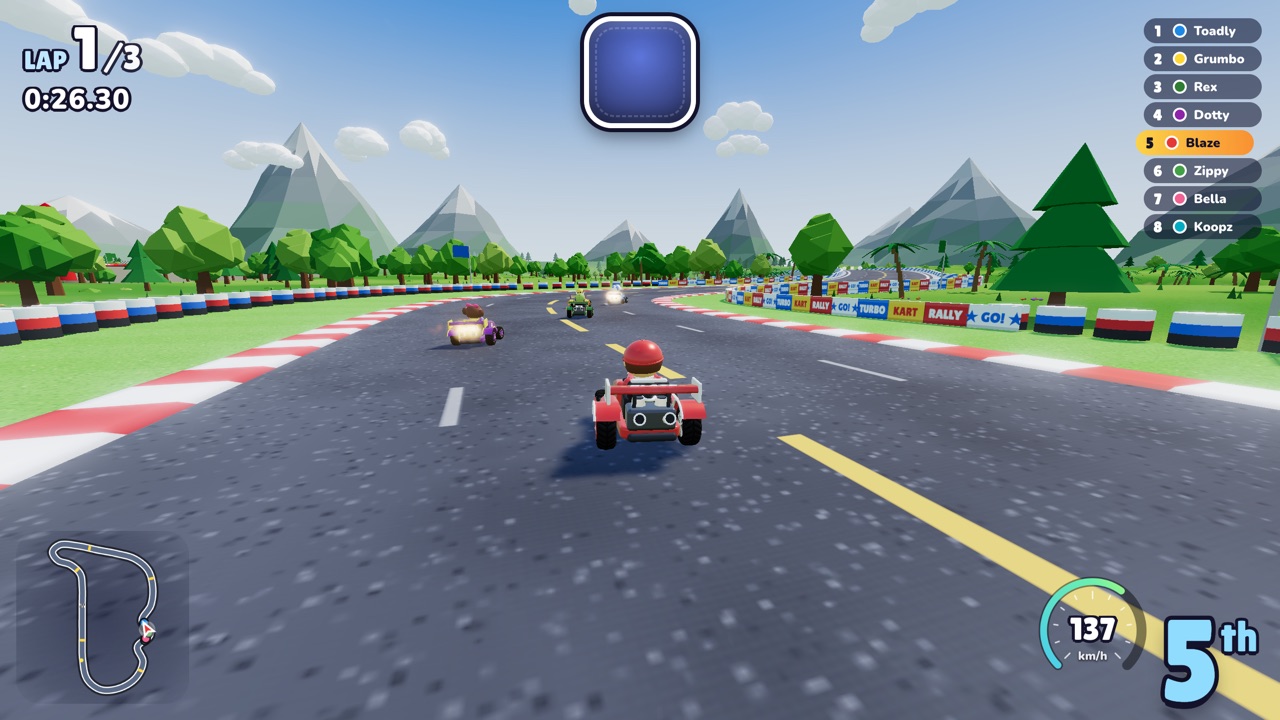
- The screen shows the lap and clock at top right, your place out of eight at bottom right, a printed minimap at bottom left, and the held item in a box at top left. The README says that if you fall off the page, a paper crane carries you back. On a phone, drag the slider at the bottom left to steer and hold GAZ for gas; there is an automatic-gas toggle at the top that starts off.
- A three-lap race took the game's own test autopilot about two and a half minutes on each chapter. A Grand Prix runs all four in order.
Controls: Keyboard: the left and right arrows or A and D steer, the up arrow or W is gas, the down arrow or S brakes. Hold Space (the README also lists Shift) while steering to drift; the in-game help calls it drift and hop. X or E uses an item, and Down plus X throws it backwards. C looks behind, Esc or P pauses and M mutes (from the README; we tried only the arrows, X and Esc). Menus work with Enter, or with the mouse or a finger. On a phone: drag the slider to steer, hold GAZ for gas, and use FREN, DRIFT, EŞYA and GERİ BAK. The README also lists gamepad buttons, which we did not test.
Click Fullscreen above the game for the largest play area. If the game does not load, use Open in new tab to play it directly from our copy.
Why it's worth your time
It is one continuous look, and it holds up. The README says every mesh, paper texture, cut-paper letter and sound is generated at run time by code, and that there is not a single asset file. We checked what the repository holds: the game is the start page plus 78 JavaScript modules and no image, model, audio or font file (the only pictures in the repository are the screenshots in its README). On screen that gives the road printed on paper, folded-card fences, hard print shadows, headings that look cut out of paper and a menu that is a physical book whose pages turn. We looked closely at the title, the menus, the class screen, the meadow chapter and a frame of the Bosphorus dusk; we did not look at the glacier and desk chapters beyond running them.
What we ran, and how far we got. In a real Chromium window on a Mac with a graphics chip, we walked through every menu with the keyboard, raced the meadow track with our own key presses for about three minutes and let the game drive the wheel with its own autopilot for the rest. Our scripted driving was poor: it spent a lot of the time off the road and ended eighth of eight, so we did not finish a race by hand and cannot tell you how the game feels at a good pace. What we did see: the kart answers the arrow keys, the game recovers from leaving the road (speed drops to zero, the kart is put back on the track), the pause key works, and the page counted 55 to 61 frames a second, with a few dips to 36 to 51 on a busy machine. Separately, the game's own test autopilot drove a full three-lap race on all four chapters through to the results screen with all eight karts finishing (137, 147, 147 and 157 seconds of race time for meadow, Bosphorus, glacier and desk). That shows the tracks can be finished, not how hard the game is.
It works on a phone. In an emulated iPhone 13, upright and sideways, the game detects the touch screen, lowers its own picture quality, and puts a steering slider and buttons on screen (GAZ, FREN, DRIFT, EŞYA, GERİ BAK, pause, and an automatic-gas toggle). Every menu could be walked through with taps, holding the gas button drove the kart, and nothing overflowed the screen. It counted 52 and 57 frames a second in that test, on a desktop graphics chip, so it says nothing about a real phone, which we did not try.
It runs from our copy with nothing else needed. Everything the game asks the network for is in the mirror: the start page, the 78 modules and three files of the three.js library (release 0.186.0, which the original loads from the jsDelivr network). That is 82 files and about 3.3 MB. Every module is byte for byte what is in the public repository; the start page differs from the repository's (the repository's is a page body that the author's host wraps in a full page) and has our standard mirror script added. Loading the copy with every outside address blocked, the game started, ran and made no outside requests. We found no analytics, accounts, adverts or use of the network in the game's code.
It remembers a little in your browser: the settings, which hints you have seen and, from the code, your best time-trial lap per track and class. We saw the first two written and did not test the time trial. Sound is generated in the browser at run time, and starts after your first key press or tap; we did not listen to it, so we cannot say what it sounds like.
Where the copy comes from. The address the author publishes, burakerdemci.github.io/kagit-kart, forwards to burakerdemci.com/kagit-kart/, and both answer from GitHub Pages. We took the copy from the second address on 24 September 2026, a few hours after the repository's last change, and checked it against the repository as it then stood. The original stays linked from this page.
Licence. The repository has no licence file and GitHub lists none, so the code is public but nothing says what you may do with it, and this is why it is not tagged open source. We host an unmodified copy as we do for other public, unlicensed games, with the author and the original linked, and the author can ask for it to be taken down through the contact in this site's footer. The three.js library inside it is MIT-licensed, and its notice is in the file. The README calls the brief Mario Kart-like; the game has its own characters, tracks and art, and we saw nothing in it taken from Nintendo.
Who made it, and with what. The README is the only place that says so: the GitHub user BurakErdemci as the owner, and Claude (Opus 5.5, in Claude Code) as the builder. The page you play, the source files, the architecture document and the 27 commit messages we read do not mention Claude or any model, and we found no other statement by the author. The tags "Made with Claude" and "Made with Claude Opus 5.5" rest on that README, which we treat as the author's own word about his game; we could not confirm it independently and cannot see how the game was actually made.
How it was made and where it lives
Published on GitHub Pages from a public repository. The author publishes as BurakErdemci. Original: https://burakerdemci.github.io/kagit-kart/. The Play button above runs our own unmodified copy, so the game keeps working here if that page goes down — which on free hosting usually has nothing to do with the author. Nothing about the game itself is changed, and the original stays linked from every page.
If you like Kâğıt Kart, try these
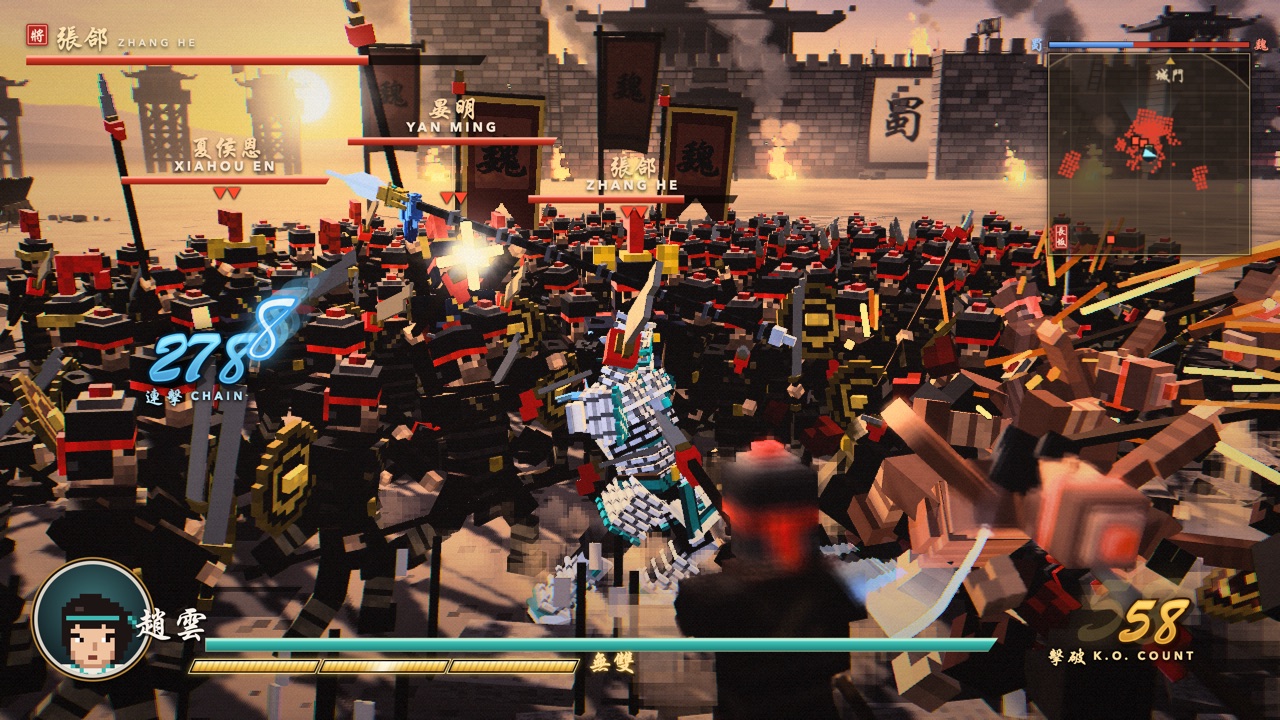
For another racer in a different look, Feiche 3D is a fan recreation of QQ Speed in one file, also tagged Made with Claude Opus 5.5 on this site. A Day on the Coral Reef is a very different thing made the same way, an animation whose author credits Claude Opus 5.5, and Voxel Musou - Zhao Yun is a Dynasty Warriors-style spear fighter.
Frequently asked questions
- Is it free, and do I need to sign in?
- It is free and needs no account. It runs in the browser with WebGL; there is nothing to install.
- Is it in English?
- No. Every menu, label and hint is in Turkish. The controls are easy to guess from the buttons and from the key icons, and this page lists them in English.
- Does it work on a phone?
- Yes, in our emulated tests. It shows an on-screen slider and buttons, and it worked upright and sideways. We did not try a real phone.
- Can I play it offline?
- This page plays our own copy, which holds every file the game needs, so it does not need the original site or any other. It needs a browser with WebGL.
- Who made it, and was it made with Claude?
- The GitHub user BurakErdemci published it. His README says he gave Claude (Opus 5.5, in Claude Code) one brief, with subagents doing the coding. That is the only place we found the statement, and we cannot see how the game was really made.
- Is it a copy of Mario Kart?
- No. The README describes the brief as Mario Kart-like, but the characters, tracks, items and the pop-up-book look are its own, and it uses no image or sound files.
- Can I use the code?
- The repository is public but has no licence, so ask the author first. The three.js library inside it is MIT.
- Does it save anything or track me?
- It saves your settings, seen hints and best time-trial laps in your browser, and nothing else. We found no analytics or other outside requests.
- Is Kâğıt Kart free to play?
- Yes. Everything on Floating Arcade is free, with no account, ads or downloads.
- Can I embed this game on my own website?
- Yes — copy the snippet below. The embedded player links back here, which is how we ask to be credited.
Embed Kâğıt Kart on your site
Paste this where you want the game to appear: