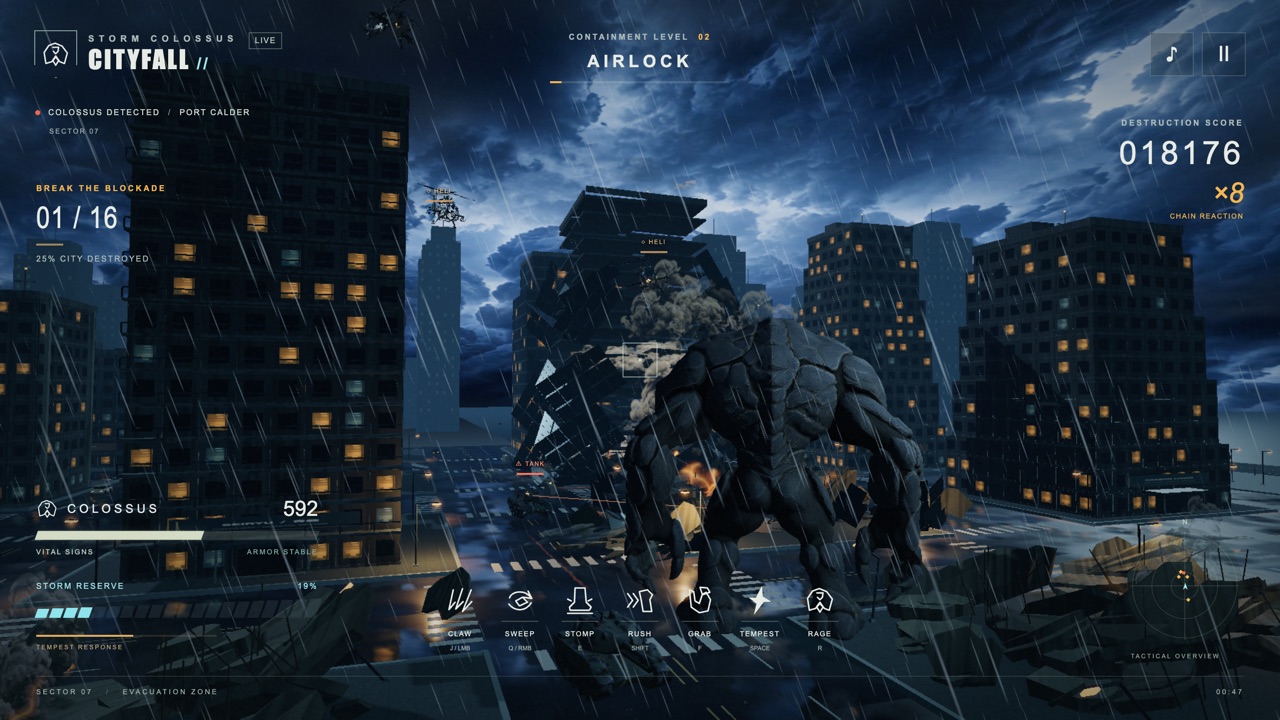
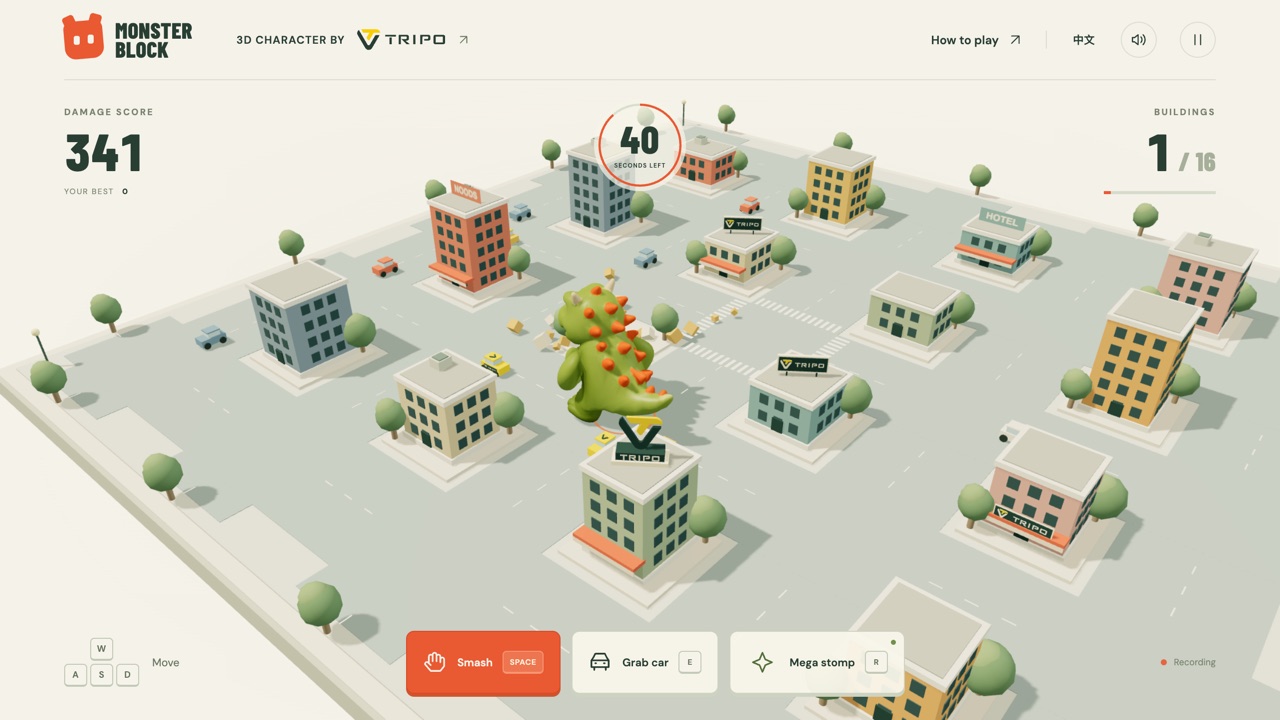
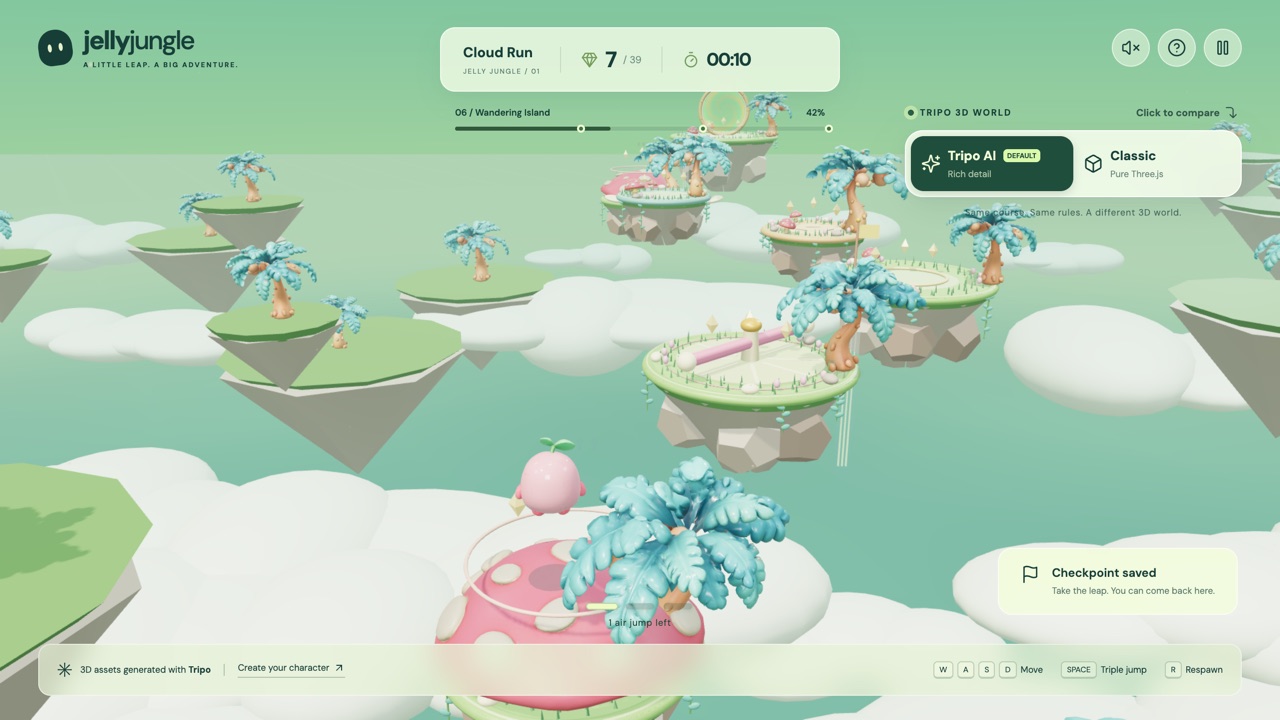
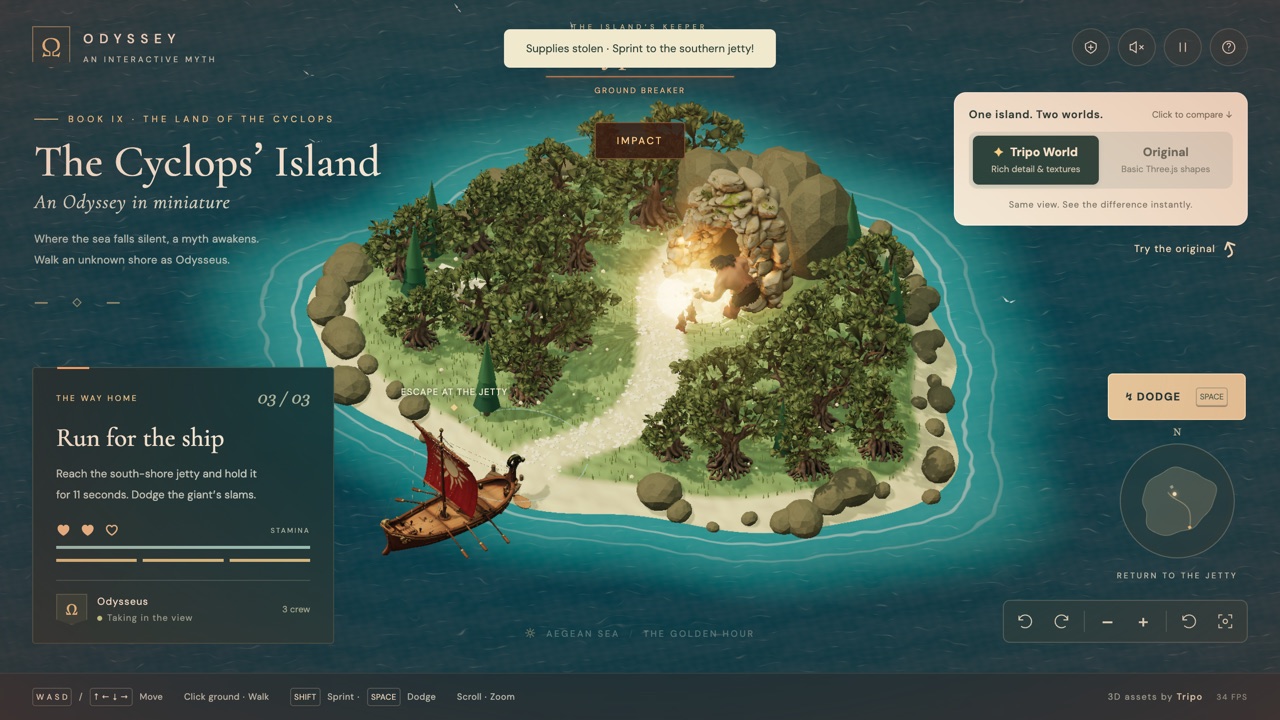
A one-button timing game from Tripo, the 3D-asset company, made for the Aichi-Nagoya Asian Games: charge and release to hop a flame across seven glowing markers between Nagoya landmarks, waking a dark miniature city as you go. It is a company showcase build, not a hobbyist's project, and it opens in Japanese with an English switch.
AKARI: Nagoya Rooftop Flame Relay is a small 3D timing game about a flame hopping across a miniature Nagoya. The city starts dark and desaturated; every successful jump lights another district, adds windows and floating lanterns, and brings colour back to the buildings. Seven jumps light the whole thing and end on a fireworks finale, a score and rank, and a poster you can save.
It is not a hobbyist's project, and the page does not pretend otherwise. It is a showcase build credited to Jared on the prompt page of Tripo, a 3D-asset company, published on Tripo's own tripo.page hosting on 16 September 2026 and tied to an event: the Aichi-Nagoya Asian Games, which the game gives as 19 September to 4 October 2026. Its footer says "Powered by Tripo" and its buildings are models labelled as Tripo-generated. The game calls itself an independent fan creation not affiliated with the Games organizers.
It is Tripo's own concept, not adapted from anyone's post, so there is no original creator to credit beyond Tripo; the catalogue links Tripo's prompt page below the write-up.
How to play AKARI: Nagoya Rooftop Flame Relay
- The game opens in Japanese whatever your browser's language is. Click EN in the top-right corner to switch to English; the choice is remembered in your browser.
- Each jump is one gesture. Hold Space, the mouse button, or your finger on the on-screen Hold to charge button, and a meter fills and drains back and forth. Release to send the flame toward the next glowing disc. A gold band on the meter is the perfect zone and a green band around it is safe; the label changes to Release now when you are in gold. Where the bands sit changes on every jump, because the discs are different distances apart. It is a timing game, not a steering game: you never move the flame yourself.
- The seven discs are split across two chapters and two separate map tiles. Chapter 1 runs from Meijo Park past Nagoya Castle and Aichi International Arena to Hisaya-odori Park, MIRAI TOWER and Oasis 21, three jumps. Then an overlay marks a transfer to chapter 2 (the game does not draw it as a street and does not count it as a jump). Chapter 2 starts at the City Museum and runs four jumps through Mizuho toward Mizuho Park's stadium.
- Scoring, from playing it: a safe landing is worth 100, a perfect one 200, and consecutive perfect landings multiply that, up to times four. A quick follow-up jump adds a 50-point tempo bonus. On a run of seven perfect jumps I finished on 3,350 points with rank S; the code awards S for seven perfect landings, A for four or more and B otherwise.
- A miss is unforgiving in chapter 1: I missed the second jump and was sent back to zero lights and zero points. From the transfer onward the game saves a checkpoint at Mizuho, and if you reload the page later, a Continue from Mizuho button appears on the opening screen. When I used it, it put me back in chapter 2 with the score and lights I had at the checkpoint.
- At the end you get two buttons, Before the lights and Your illuminated city, that swap between the dark and lit maps from the same camera. Save your poster downloads a real 1800 by 1200 PNG with the title, dates, your score and light count, and the note that this is an independent fan creation. Pause, restart and a sound toggle are always on screen.
Controls: Hold Space, the mouse button or a finger on the Hold to charge button to fill a meter, and release to jump. The meter sweeps back and forth, so you are timing where it is when you let go: the gold band is a perfect landing, the green band around it is safe, and anywhere else the flame falls short. The bands move on every jump because the distances differ. The pause and restart buttons sit top left, and the Tripo 3D / Simple 3D switch top right changes how the city is drawn without losing your run.
Click Fullscreen above the game for the largest play area. If the game does not load, use Open in new tab to play it directly from our copy.
Why it's worth your time
Every catalogue entry here was found through Tripo's GPT-6 Astra prompt collection, and this one is Tripo's own showcase rather than a creator's post about their own work: Jared's prompt page describes the game, lists the whole build brief, and offers it as a prompt you can paste into ChatGPT. Tripo publishes builds like this to show off its prompts and its 3D-asset product, and this one does that openly.
The Tripo 3D / Simple 3D switch is the most honest bit of design here. Tripo 3D uses seven downloaded 3D models labelled Tripo P2 (the castle, arena, MIRAI TOWER, Oasis 21, the Mizuho stadium, a generic mid-rise and a tree); Simple 3D redraws the same city from plain blocks made in Three.js. You can flip between them mid-run without losing your score, and the difference in the finale is striking: a castle drawn as a stack of pale blocks becomes a teal-roofed one.
There is a pitch inside the game too. The results screen has a Create your own shachi link that goes out to Tripo Studio, and an Add your model to the city button that takes a GLB file of up to 20 MB from your own device. I did not try either: the game says the file stays on your device, and the Studio link leaves this site. Generation and downloads there fall under Tripo's plan terms, as the game itself notes.
The map is real geography made small. The About panel says the two tiles use different scales, that distances, heights and night lighting are adapted for play, and that Chapter 1 draws on the 22 August 2026 torch-relay route while Chapter 2 draws on the 16 September one, both already past. I only checked what the game shows: the landmark names and their rough placement are as it labels them, and the buildings are stylised, not survey-accurate.
Weight and offline: the mirror is about 9.4 MB, mostly the seven models, and every file the game asks for is a local one, so it runs offline. The game keeps your best score, language and checkpoint in your browser's local storage. In my run it requested nothing beyond its own files. The original page tries to load a Cloudflare analytics script that its own security policy blocks, and the copy leaves it out. It needs WebGL, and it says so if it cannot start.
How it was made and where it lives
Published on tripo.page, the hosting Tripo (a 3D-asset company) uses for the recreations of GPT-6 Astra demos in its prompt collection. The author publishes as Jared. Original: https://akari-nagoya-rooftop-relay.tripo.page/. The Play button above runs our own unmodified copy, so the game keeps working here if that page goes down — which on free hosting usually has nothing to do with the author. Nothing about the game itself is changed, and the original stays linked from every page.
A company showcase, not a hobby project
Built by Jared at Tripo. This page plays a build made at Tripo (16 September 2026), not something a hobbyist made on their own. Tripo publishes these builds to show how a prompt turns into a playable scene, so expect a Tripo Studio pitch on their own pages.
If you like AKARI: Nagoya Rooftop Flame Relay, try these
City Atlas is the other place here that turns a real-world city into a small 3D diorama, though it generates a new one each time and has no goal. Tokyo DisneySea is another unofficial 3D map of a real Japanese place, one you explore rather than play.
Frequently asked questions
- Who made AKARI?
- Tripo's prompt page credits Jared as the author. It is published on Tripo's own tripo.page hosting, dated 16 September 2026, and it is a company showcase for an event, not a personal project.
- Is it adapted from someone else's game?
- No. Unlike some other Tripo builds in the catalogue, it is not a rebuild of a creator's post; it is Tripo's own concept.
- Is it official Asian Games material?
- No. The game says it is an independent fan creation not affiliated with the organizers, and its About text says it uses no official logo or mascot. It does base its two chapters on real torch-relay sections and links to the official pages from its About panel.
- Can I play it in English?
- Yes. It opens in Japanese by default, and the JP / EN switch in the top-right corner changes the whole interface, including the About text. Your choice is remembered.
- Does it work on a phone?
- Yes. Hold your finger on the Hold to charge button and lift to jump; I checked this with touch events in an iPhone-sized window. The map is small and the score banners crowd it, so it is nicer on a larger screen.
- What do the gold and green zones mean?
- Release the meter in the green band and you land safely; release it inside the narrower gold band for a perfect landing, which scores double and builds a combo multiplier.
- Does the offline copy work?
- Yes. All seven models, the fonts and the code are local, and saving the poster works from here. The links to Tripo Studio and to the official Games pages still go out to the internet.
- Is AKARI: Nagoya Rooftop Flame Relay free to play?
- Yes. Everything on Floating Arcade is free, with no account, ads or downloads.
- Can I embed this game on my own website?
- Yes — copy the snippet below. The embedded player links back here, which is how we ask to be credited.
Embed AKARI: Nagoya Rooftop Flame Relay on your site
Paste this where you want the game to appear: