A one-button rhythm platformer in the style of Geometry Dash, with a crab as the runner. You run right at a set speed and press one button to jump over spikes, land on blocks, and fly a ship or flip gravity through six levels from Easy to Demon, each with three secret coins, a practice mode with checkpoints and a level editor. The repository's README says Claude Opus 5.5 built it in one session. Open source under the MIT licence.
Crab Dash is a one-button rhythm platformer. A small orange crab runs to the right at a set speed and you have one control: press to jump. Spikes and blocks come at you in time with the music, and touching the wrong thing sends you back to the start of the level. The title screen is a glowing purple grid with the crab on a white line, and the levels change colour from blue to red as they get harder. There are six levels, called Low Tide (Easy), Crab Walk (Normal), Coral Drift (Hard), Shell Shock (Harder), Riptide (Insane) and The Abyss (Demon). The README says each has three secret coins and its own song.
It is a fan project, and says so. The README calls it "an independent fan project inspired by Geometry Dash" that is not affiliated with or endorsed by RobTop Games, and says the art, music and levels are original. It is open source under the MIT licence, by the GitHub user itsdannyt, at github.com/itsdannyt/crab-dash. The repository was created on 23 September 2026, has eight commits, and its last one came about 100 minutes after the first.
The credit, stated as narrowly as we can. The repository's README has a section called "How it was made" that says: built by Claude Opus 5.5 (Anthropic's AI model) in one session, from a single prompt plus one round of feedback, with the physics engine, the art (drawn in code), the music (synthesised live in the browser) and all six levels written from scratch. That paragraph has been in the README since the very first commit, on 23 September 2026. It is the author's own statement, in the repository, and it is the only place we found it: the game's page says nothing about who or what made it, and we did not find the claim anywhere else (we did not search social media for it). We can see the code and the commit history, but not how the code was actually produced, so we cannot confirm the model, the one session or the one round of feedback. The two Claude tags on this page rest on that README line alone.
How to play Crab Dash
- Open it and click, tap or press Space at the title screen (the words are there, and the start is held back for a moment while the font loads). A menu follows with a big green play button, an icon kit button and a pencil button for the level editor. Play opens the level picker: a card for each level with its difficulty face, its star rating, three empty coin slots, and two progress bars, one for normal mode and one for practice mode. Use the arrows on the sides or the arrow keys to change level, and click the card or press Space to start.
- Once a level starts, everything is one button. Click, tap, or press Space, Up or W to jump. The code keeps a short buffer for a press made just before landing. The README says the same button also flies, flips and so on in the other modes (ship, ball, UFO, wave, robot and spider); the level data names all six, and we did not fly through each. The bar across the top shows how far through the level you are, and a big "Attempt" number counts your tries.
- Esc or P pauses, and R starts the attempt again at once. Practice mode adds checkpoints: Z drops one, X removes the last, and the game also drops some by itself every few seconds while you are on the ground or flying. We did not try practice mode ourselves, so we cannot say how it feels.
- Progress bars, your best percentage, coins and stars are saved. The icon kit lets you pick from eight crab designs and a look for each mode, with colours and a glow. The level editor is behind the pencil button; it opens on a "My Levels" page with a New Level button, and the README says you can build, playtest and save your own.
Controls: Click, tap, Space, the Up arrow or W: jump (or fly, or flip, depending on the mode you are in). Esc or P pauses, R restarts the attempt. In practice mode, Z drops a checkpoint and X takes the last one away. On the menus, Space or Enter picks, and the arrow keys or A and D move between levels.
Click Fullscreen above the game for the largest play area. If the game does not load, use Open in new tab to play it directly from our copy.
Why it's worth your time
Where this copy comes from. The address playcrabdash.com is a GitHub Pages site: it answers with the headers of GitHub's own servers, and the repository has a CNAME file naming that domain. So whoever controls the repository controls what the domain serves; we did not look up who registered the domain. When we mirrored it on 24 September 2026, the page and its ten script files were byte-for-byte the files in the repository at commit f60dc60 ("Create CNAME"). The mirror adds the site's standard shim to the start page and turns the one web font into a local file, and nothing else. It also carries the MIT licence file. The original stays linked from this page.
What the original page loads besides the game. The start page pulls one thing from another company: the lettering font, Lilita One, as a stylesheet from fonts.googleapis.com and a font file from fonts.gstatic.com, which are Google's servers, so Google sees the visit. There is nothing else: no analytics, no adverts, no tracking script, no cookies, no calls to any other server, and the game code does not use fetch or XMLHttpRequest at all. On our copy the font is a local file, so the copy makes no request to any other site (we blocked everything outside our own server while loading it and nothing was refused).
It keeps a save in the browser. One local-storage entry holds your best percentage and attempts per level, coins, stars, icon choices, volume settings and any levels you build. Clearing site data wipes it. If storage is blocked the code catches the error and carries on for that visit.
Frame rate and feel. On a desktop it held 60 frames a second in Chromium at 1280 by 720, on the title screen and in a level. The game runs its physics at a fixed 240 steps a second whatever the screen does, which the code comments give as the reason the same level can also be checked by a Node script with no browser. That script, tools/solver.js in the repository, is what the README means by "every level is checked by an automated solver": it searches for a run that reaches the end. We ran it for Low Tide only (it says beatable, a run of about 66 seconds, with 330 button-down frames out of 3,952) and did not wait for the other five, so we have not confirmed the README's claim that all six can be beaten and all coins reached.
What we played. Timing jumps by hand-written scripts, in real time, we got no further than 21 percent of Low Tide in 21 attempts, which is a fair sign that the game is not trivial even at Easy. Then we fed the solver's exact run into the game one frame at a time on a controlled clock, and the crab reached the flag on the first attempt: the screen said LEVEL COMPLETE at 100 percent, the game counted 64 jumps, one coin was collected on the way, and it saved the level as done. That shows level one can be finished in our copy; it says nothing about how hard the level is for a person. We loaded all six levels and saw that they start and change colour, but we did not play the other five to the end.
Sound. The README says the music is made live in the browser, and the code creates the browser's audio system on the first click or key press. We did not listen to it, so we cannot say how it sounds or how loud it is. There is a volume setting in the save data, and no audio files are loaded.
On a phone. It is built for one, in one orientation: held upright, a notice covers the whole screen asking you to turn the phone sideways. Sideways in an emulated iPhone 13 (844 by 390) it fills the screen, the page does not scroll, and taps reached the menus and jumped the crab, six jumps from eight taps. We did not try a real phone, or how it feels with a thumb and the phone's own latency, which matters in a game like this. It does not appear to read a gamepad.
The copyright question, plainly. The idea, the one-button rhythm format and the rows of spikes are those of Geometry Dash, which is RobTop Games' game. The README says the physics numbers (speeds, gravity, jump height, pad and orb heights) follow measurements published by that game's community, and the comment at the top of the game's core script cites a GitHub project of decompiled Geometry Dash physics code and a fan wiki as its sources. The repository says its art, music and levels are original, and we saw no Geometry Dash art or music in the files. If you are a rights holder and have a concern, use the contact in this site's footer.
How it was made and where it lives
Published on GitHub Pages from a public repository. The author publishes as itsdannyt. Original: https://playcrabdash.com/. The Play button above runs our own unmodified copy, so the game keeps working here if that page goes down — which on free hosting usually has nothing to do with the author. Nothing about the game itself is changed, and the original stays linked from every page.
If you like Crab Dash, try these
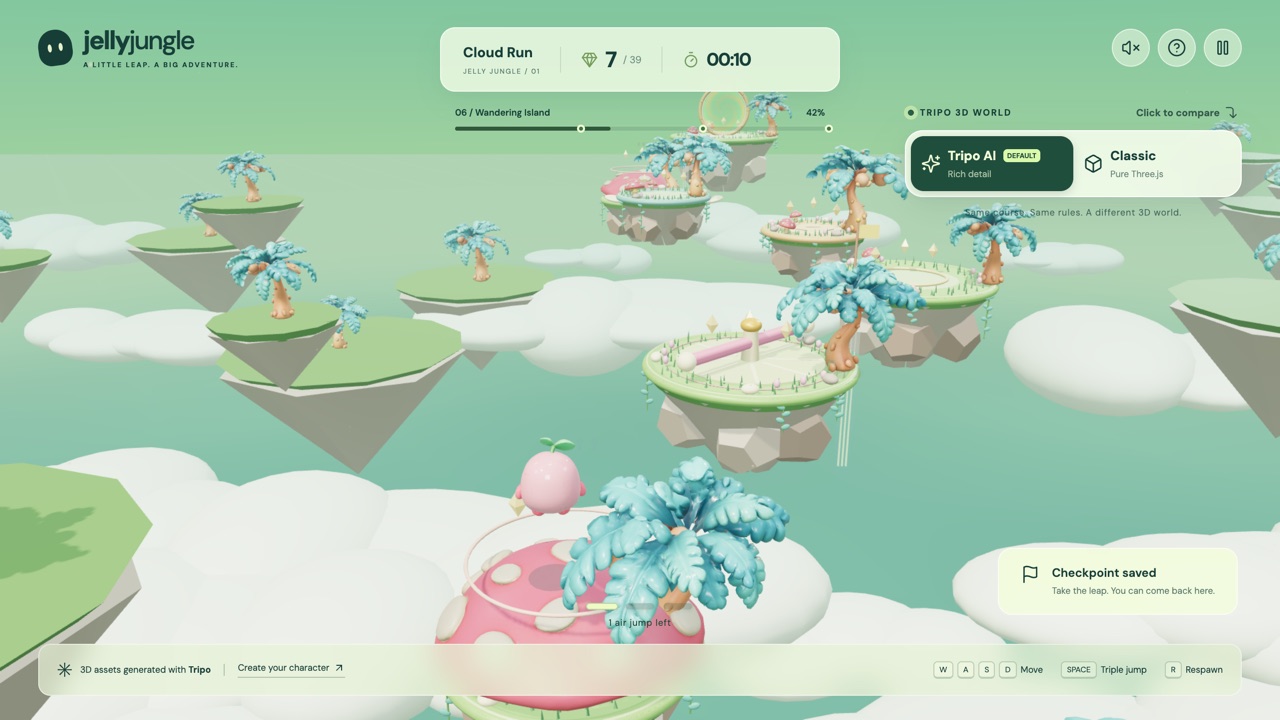
For another game from a README that credits Claude Opus 5.5, see Voxel Musou - Zhao Yun, a fan-made spear fighter in blocks, and A Day on the Coral Reef, a pixel-art reef that runs itself. For other side-scrolling platformers, Mushroom Arcade is a classic-style runner with keyboard and touch, and Jelly Jungle is a softer one.
Frequently asked questions
- Is this Geometry Dash?
- No. It is a separate, unofficial game in the same style. Its README says it is an independent fan project inspired by Geometry Dash, not affiliated with RobTop Games, with original art, music and levels.
- Who made it, and was it really made by Claude?
- The GitHub user itsdannyt. The repository's README, since its first commit, says Claude Opus 5.5 built it in one session from a single prompt plus one round of feedback. We can read that statement but cannot see how the code was produced, so we cannot confirm it.
- Does it work on a phone?
- Yes, held sideways: taps start it and make the crab jump. Held upright it shows a notice asking you to turn the phone. We only tried an emulated iPhone, not a real one.
- Do I need an account, and does it track me?
- No account. The original page loads one font from Google's servers and nothing else from outside; it has no analytics or adverts. Our copy makes no outside requests. It saves your progress in your browser only.
- Is it free and open source?
- It is free to play. The repository has a licence file with the MIT licence, so the code can be reused under that licence.
- Is Crab Dash free to play?
- Yes. Everything on Floating Arcade is free, with no account, ads or downloads.
- Can I embed this game on my own website?
- Yes — copy the snippet below. The embedded player links back here, which is how we ask to be credited.
Embed Crab Dash on your site
Paste this where you want the game to appear: